See here for my good friend Andrew Slack's Huff-post on chocolate, fair trade, and Harry Potter. They go together better than you might think.
Also, just because this is my 666th post doesn't mean that I think Harry Potter is satanic.

See here for my good friend Andrew Slack's Huff-post on chocolate, fair trade, and Harry Potter. They go together better than you might think.
Also, just because this is my 666th post doesn't mean that I think Harry Potter is satanic.
See here for my Q&A on the Forward's food blog with former NYT restaurant critic Mimi Sheraton, who was a pleasure to speak with.

I have evolution and selective breeding on the brain as I'm finally reading Guns, Germs and Steel, which answers all those questions you never thought to ask, like "Why didn't we domesticate zebras?" (Answer: they bite and don't let go.)
And so when I last took my dog to the field across the street from our new digs in Northampton, MA, I couldn't help but think the following: after thousands of years of survival of the fittest, learned behavior and so forth, dogs have scored an extremely secure niche in the human world. For proof, consider the (shameful) existence of cupcakes for dogs.
Formerly dogs had to be good hunters and guardians to earn a spot at the campfire, as well as the bones and scraps of the kill. But today's dog earns its keep by doing goofy stuff like this.
My dog Oli, the pinnacle of canine evolution, has perfected his meal ticket by perfecting his desirability in terms of companionship. Because who could answer "no" to the question so clearly posed by the above photo: won't you be my pal?

There is only one word to describe the cinnamon-chili braised brisket I recently made: "uf."
Though I've used a Jewish word to describe it ("uf" is as Jewish a word as "Jewish"), this one was not cooked with tomato paste, carrots and the other accoutrements that so often accompany this cut of meat when served by members of the tribe. This brisket was a little smoky, a little spicy, a little sweet, and a lot delicious.
It was a Southwestern fantasy brisket, perfect for a day of watching Southwestern fantasy movies. My friends and I holed up for a Sergio Leone movie marathon, and as we've learned before, braised meats are a movie marathon's best friend; just thinking about it makes me want another pork butt pancake.
I like to think that I did for brisket what Leone did to the Western: I took something already very good, ignored genre, added some foreign flavor and weird music. So maybe I didn't add the music, but it did come in later.
Three days before I defrosted a three pound hunk of locally raised, grass fed beef, which by the way cost as much per pound as "natural" supermarket meat (about ten bucks). I believe that we should all be cutting down on our meat intake, but I also believe that there is nothing quite like an enormous piece of raw meat to stir one's blood. Quinoa just doesn't have the same effect on me.
As I prepared the meat my dog wandered in with a dazed look on his face, like he was getting a contact high from the aroma. I made him a little dog agua fresca by pouring the juices from the bag into his bowl.
Neither he nor I could leave the kitchen while the meat was around. I tasted a piece of it raw. I tasted a piece of it seared and unseasoned: pure cow. And then it disappeared for several hours into a dutch oven inside of a non-dutch oven. I could have done it in the crockpot, but this way the radiant heat from the oven would also warm the house, killing two birds (and one cow) with one stone.
For spices I used cinnamon, whole dried chiles and black peppercorns, chipotle powder, an absurd amount of cumin that still wasn't too much -- when have you ever thought "this has too much cumin?" -- some coconut sugar and cider vinegar that was still fermenting, so somewhere between cider and cider vinegar. It simmered with all of the above plus a little water and several seriously browned onions.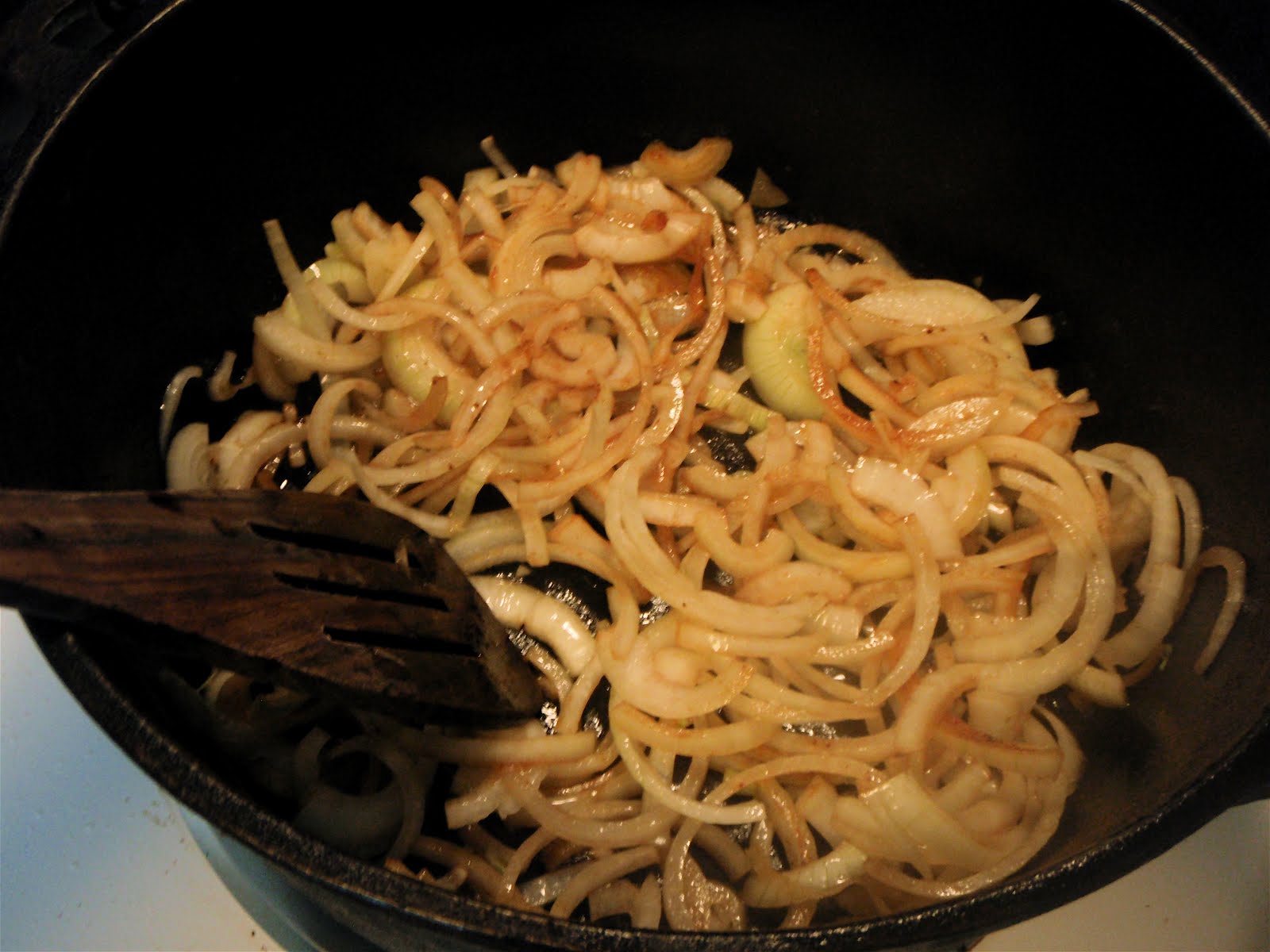
After a few hours in the oven-within-the-oven, the meat had become tender and the liquid, onion and spice mixture reduced to fantasy beef candy. I pulled the meat, keeping the strands as long as possible (I love brisket for that -- meat noodles) and put it back into the pot to marinate for another two days with all of the goodies.
During one of the Leone movies we reheated it and then ate it on slices of Iggy's with sprigs of cilantro and a little smoky bean dip I'd made as well.
And then the weird music did come in. It was the squealing of our ecstatic stomachs.
Uf.

It's been said that life is what happens when you're making other plans, but I think that statement rings more true with a few tweaks: life is what happens only when you plan it.
When I was a touring sketch comic, life was interesting by default. A little too interesting, which is one of the many reasons I'm no longer on the road. Now most of my days are spent in front of the friendly little robot on which I'm currently typing (R.W. Apple called his "the piano"), and if I don't force myself to get up, get out and go stumbling around the woods just for kicks or for wild edibles, it doesn't happen.
Last Friday I was reflecting on how long it had been since I'd slept outside, and so Elise and I hastily factored in a camping excursion for that night. What I wanted was to scale a mountain with everything we needed on our backs, but that wasn't going to happen with only a few hours' notice, so we settled for car camping at a nearby state park. Of course campfire cooking would be part of the allure.
We arrived at dusk and barely had time to set up the tent and find firewood, so it was a good thing we didn't plan anything elaborate for dinner, else we wouldn't have eaten for hours. Instead we had burritos I bought that afternoon. We nestled them in the fire pit to warm up, protected by their aluminum second skins.
Breakfast the next day consisted of foraged tea -- hemlock, not to be confused with Plato's last beverage -- bacon cooked over the fire and eggs cooked in the bacon fat. Yeah, we went there.
Even though we had a cell phone and a car and were parked just off of a paved road that led back to civilization, the trip felt rough. It was cold, the ground was hard, and the dog kept waking up and shifting around throughout the night, and in a tent as small as ours it was impossible to not notice.
Also impossible to not notice was the howling wind and the howling coyote that got us up in the middle up of the night and made us wonder about whether the tent was a strong enough psychological barrier against predators, since it certainly wasn't much of a physical one.
In the morning I realized I'd been on edge since we got there, either because I was cold, busy coaxing flames out of damp wood, or just unused to unfamiliar surroundings. As the title of the post says, I've gone soft.
That's when I decided I had to turn things around. I took a swig of the bright, warm hemlock tea, straining the leaves out with my teeth, took off all of my clothes and jumped into the pond.
The air temp was in the 30's, and since there wasn't any ice on it I'm guessing the pond was in the 40's. I remember one instant of opening my eyes under the frigid, murky water, and it seemed that if I lingered any longer my head would implode from cold. I dried off with my pajama pants and sat on a piece of cardboard by the fire, watching my feet steam. Until then, I didn't know that feet could steam, and I wouldn't have learned that from sitting in the apartment watching Netflix.
As an 18th century Hassidic mystic once said, "Just as the hand, held before the eye, can hide the tallest mountain, so the routine of everyday life can keep us from seeing the vast radiance of and the secret wonders that fill the world. "
Just as a computer screen can hide from view the nearest state park, so can jumping into a freezing pond remind you why it's important to plan the good stuff.

No, that's not a victim of the Ice Truck Killer: it's a persimmon.
My new home is in the Pioneer (or "Happy") Valley of Western Mass, and luckily it's a fun place to eat. There are farms, there are restaurants, there are farm to table restaurants, and so forth. But one of my favorite food destinations isn't a restaurant. In fact, it's more like a warehouse.
The crowded aisles of Tran's World Food Market in Hadley are packed with odds and ends from all corners of the earth. Need chili paste? You'll feel like a kid in a chili paste store. Need coconut vinegar? No, you don't even know what coconut vinegar is, but you buy a bottle for $1.50 anyway.
The market has assuaged any concerns I had about getting all of the ingredients I need and no longer living in an urban area. Tran's World Food Market might have as many items as all of Boston's ethnic markets crammed into one, or a least it looks that way. One day there were shrink-wrapped hunks of hacked up, spiky jackfruit at the register: an impulse buy.
I recently discovered a freezer section dedicated to whole, dirt cheap, exotic frozen fruit. I bought a mesh bag of frozen mangosteens for about six bucks and a bag of rock-hard, icy persimmons for under two bucks. Sustainable? No. Irresistible? Yes.
Unable to restrain myself, I started eating them still frozen on the drive home. A frozen persimmon is kind of a fun thing to eat, assuming you're as weird as I am, but a frozen mangosteen has as much flavor as a snowball. Disappointing considering I've been told they're the world's best fruit.
However both were stellar once thawed: the fruits had all reached peak ripeness before being John Spartan-ed. But here's the strange thing. I took a bite of a frozen persimmon then left it to thaw in the fridge overnight. In the morning, most of the persimmon had leaked out onto the plate and gelled into an irresistible glop.
I slurped it up for breakfast.
I've tried to replicate the experience by cutting others with a knife and letting them thaw, but little juice and no jelly has resulted. I'd ask if anyone has any advice, but I can't imagine that anyone does.
I think I just need to savor the freak experience of eating spontaneously occurring fruit goo for what it was.
Earlier this month Andrew Sullivan posted Adam Ozimek's attack on schools gardens, which he (Adam and then Andrew quoting Adam) called "yuppie vanity." There's a kernel of truth in that statement, but it should be dwarfed by the rest of the ear.
I too find fault in the elitist elements of the local foods movement and in gardens whose sole purpose is to make rich people feel better about already having the world's finest food supply. And any vegetables are better than no vegetables, whether they're frozen, canned, or made into "space dinners" for astronauts.
Where Sullivan and Ozimek misfire is in their unmitigated praise of frozen veggies over school garden programs. If Sullivan/Ozimek were writing from a place of concern for the well being of poor children, they would at least acknowledge that we should emphasize frozen vegetables in addition to school gardens.
But that would make for a far less catchy post. They are playing the "I am an opinionated blogger, listen to me" card and the often-used in conjunction "and I speak for the poor, not you elitists" card, though of course they too are members of the elite.
Changing the way that people eat is not exclusively about changing what they eat. It's about changing perception. With school gardens we're often talking about kids who actually don't know that vegetables are grown in the ground: that's something that many educators report hearing. If that's where you're coming from, it doesn't matter how many frozen vegetables you're told to eat. You won't be inspired to.
School gardens a) yield incredibly valuable fresh produce in areas that often have no produce (not even frozen) and b) provide even more valuable inspirational teaching tools. Condemning them as ineffective or superfluous is just as short-sighted as condemning an inspirational work of art, like the protest songs that fueled the anti-war movement in the 1960's. Especially if you could also eat that work of art, and it was delicious.
Which is better motivation for eating more vegetables: witnessing the miraculous journey from seed to carrot, and then pulling up that piece of food that you grew from the dirt with your own two hands and taking a bite, or being handed a bag of frozen broccoli florets? Teach a man to fish, etc.
Both bloggers also ignore the new data in favor of school gardens that prompted the attack. And Ozimek falls into the trap of using the word "progressive" as a negatively charged adjective without explanation, as in the sentence "Unfortunately, it seems that these genuinely useful policies and programs are being bogged down with wasteful progressive ideas."
Ozimek describes the values of fresh food champions like Jamie Oliver and Alice Waters as "wasteful upper-class liberal obsession over local, fresh, and organic foods." Reminder: local, fresh, organic food is not exclusive to the upper class. That's just the stigma it carries in the U.S. today. Not to idealize the diet of the poor, as Rachel Laudan cautions us against doing, but local, fresh, and organic is how the whole world used to eat and how much of it still eats by default and not because it's cool. Such foods get the shaft in being branded as a departure from brand, spankin' new systems of food production labeled "conventional," though they are anything but. Of the two, "conventional" produce is the new radical.
Local for the sake of local is not a luxury, as Ozimek suggests. It is a powerful notion that keeps more money in the communities these children live in and that makes a tremendous qualitative difference in the lives of those it effects: the farmers who receive more of every dollar, patrons who experience the social benefits of having their own farmers market, and those who seek alternatives to the risks posed by industrial agriculture.
Sullivan/Ozimek are also guilty of determining what poor people should do without consulting them, making them appear at least as elitist as any goat cheese and arugula devotee. Ultimately, poor people should get to decide what poor people get to do, and the important thing is to provide them with a range of options so that they can pick the one that works best for them. Because, shockingly, poor people are actual people, and are different from one another, and some of them are able to and want to grow some of their own food. Thankfully there are several programs that help them do so.
Many of the vain yuppies being attacked are also big fans of frozen vegetables. Most of the people I know who grow their own food and shop at farmers markets also use frozen vegetables, and none of them are wealthy. In other words, it's not like people who garden are rich fools and people who eat frozen veggies are poor heroes. The lines are not as distinct as Sullivan/Ozimek make them out to be.
What we have here is a typical case of curmudgeonliness clouding vision. This is precisely the perspective that was dismissive of public interest in organic food, now one of the fastest growing sectors of agriculture, and then of local food, now being championed not only by "yuppies" but also by Walmart (for better or for worse).
There are a lot of poor, blue-collar people the world over who grow their own vegetables. It is neither ignorant nor idealistic to suggest that more people do so, and that's not to exclude frozen vegetables from the mix.
Should lower income households try to grow their own vegetables? Should lower income people try to eat more frozen vegetables? The answer to both questions is yes, though the former has the power to create a greater change, as the new data suggests, and if you can only dismiss that as a pipe dream of the privileged, then you should wipe the icy peas and carrots from your eyes.

A real egg has a thick shell that you actually have to crack, not just look at the wrong the way.
A real egg has a carrot-colored yolk, and it doesn't drip out of its shell: it leaps!
A real egg tastes like chicken butter.
The above photo features (real) eggs from my local far-mar scrambled with leeks, which is one of my favorite combos on earth, much more so than Combos. (Of the two, I prefer the one that doesn't sponsor a race car.)
When cracking the eggs to make this ideal breakfast, which also featured pan roasted taters and raw Napa cabbage with a sprinkling of cider vinegar, I remembered just how good a real egg can be, especially in contrast to the alleged supermarket counterparts that I've been using lately.
Don't be fooled by supermarket (or even gourmet supermarket) eggs claiming to be real eggs just because they come in cardboard and prominently display an image of a field at sunrise. A real egg comes from a chicken that has room to move about and eats real food, as opposed to sitting in a pen eating pellets that are technically organic but probably come from China. A real egg might come in a package that (gasp!) has nothing on it all.
Pseudo-real supermarket eggs may come in cardboard, they may be brown, and they may make claims like "cage-free," "organic," or "all-natural," but they just don't compare with eggs raised by your local dirty hippie socialist farmer.
A real egg has backbone. And I like to think that some of that backbone transfers to eater. But not literally, which would be gross.

This Knobbed Russet was one of the best -- hmm... maybe the best -- apples I've ever eaten. It is not, however, one of the best apples I've ever looked at.
"Knobbed" is not an adjective I want used to describe my fruit. "Knobbed" is an adjective I want used to describe old-timey walking sticks sold at craft shops for tourists in Asheville, NC. "Juicy" is an adjective I want used to describe my fruit.
Luckily, the k.r. was both knobbed and juicy, unlike the mealy Sheep's Nose apple (another heirloom) I once bought from Cornell Orchards in Ithaca. What impressed me most about this dingy looking fruit was its aroma: like biting into a perfume bottle, but without shards of glass piercing your tongue.
Just another reminder, as if you needed it, that heirloom produce can blow supermarket produce out of the water in terms of depth, subtlety, and mildly off-putting, quaint names.
I'm reminded of something someone recently said to me while I was helping to prepare a post-wedding brunch in Chesapeake, VA. I paraphrase:
"I've tried growing organic but it just doesn't work. At least the vegetables are never pretty."
There a lot of things I dislike about that comment, but here's the most obvious. If the most important criteria for food was the normative standard for "pretty," wouldn't someone have eaten Cindy Crawford in, like, 1991?
Yet she lives. Therefore, eat knobbed apples.
See here for my post on the Forward's food blog about pickles, Jews, and Jewish pickler Sandor Katz (author of the awesome Wild Fermentation).

As you may recall, I'm mad for pawpaws. I have an article about them in the current issue of Edible Rhody, which you can read here and which you can read a little bit of here:
"The pawpaw could very well become mascot for the American local foods movement, a rallying point for both growers and consumers seeking to reconstruct our forgotten national food identity. Nothing better embodies our terroir than this truly American fruit found nowhere else on earth and so deeply embedded in our national history. Certainly not the apple, which, like Borat, is from Kazakhstan.
As we pay closer attention to where our food comes from, why not look a little further back? Even hardcore farm-to-table restaurants like the flagship Chez Panisse are cooking with crops that originated on other continents. In the quest for authenticity, shouldn’t an indigenous plant that our first president grew score higher than, say, a cauliflower?"
The NYT reports that agribusiness giant Monsanto is taking a nose dive, with market shares dropping 42%. Yay for the local foods movement? Not exactly.
If like me you thought their market shares might be suffering from increased farmers markets and CSA shares, you're wrong. This is less about anti-frankenfood pressure and more about farmers buying cheaper, generic GMO products from (surprise) China.
Which is perhaps an even worse state of affairs. If you're going to use genetically modified seed that can spill into your neighbor's farm and cause them to be sued for intellectual property theft, and if you're going to grow crops with "terminator genes" that are programmed to produce sterile second generation crops so that you can no longer save your seed but have to go back to Monsanto for your annual fix, the least you could do is buy American.
Granted, Monsanto f's with more crops that potatoes, as the title of this post points out, but I'm willing to sacrifice accuracy for puns.

I threw together this witch's brew when I was up in Vermmmont over the summer. Rather than drink one of the dubious herbal teas (think "natural" ingredients) someone had left in our cabin, I just went out to the lawn.
There I found plenty of wild edibles just waiting to be steeped in an old coffee pot and drunk by an amateur forager/food writer. These included raspberry leaves, plantain, red clover blossoms, oxalis (aka wood sorrel) and bee balm.
It was a little minty from the bee balm, a little tangy from the oxalis, it was made richer by the plantain, and the red clover blossom and raspberry leaf did absolutely nothing except make me feel good about myself for knowing I could use them in tea. I'll have to try both on their own to understand their deal.
Was it the best tisane I've ever had? If you said "yes" you clearly haven't read my post entitled "The Best Tisane I've Ever Had." But it was great, it was free, it was wild, it connected me to the Earth and made me grateful to be somewhere where I could trust the safety of the wild edibles. (I'm not afraid of the plants, I'm afraid of the pesticide.)
But best of all, it didn't have "zinger" in the title.
Also, sorry to disappoint any stoners who were expecting a post on tea made from marijuana. In case I ruined your high, here's a picture of a Grateful Dead bear to cheer you up again:

If I had to be stuck on a desert island with only one book, it would be a book about how to escape from a desert island. If I could bring only one record, it would be an audio recording of the book about how to escape from a desert island. And if I could bring one movie, it would be Citizen Kane. Duh! But if I could bring one foodstuff, it would be slightly fermented apple cider.
Cider that has just begun to ferment is a natural, magical tonic complete with god-given bubbles and a flavor that thoroughly trounces sweet, flat cider, or even soda for that matter. I'm not talking about hard cider, which I also love, but which I wouldn't want to drink at all hours of the day as I do this stuff, which I drink like it's going out of style.
And it is. When people buy cider and it gets a little fizzy, they usually throw it out. But that's when you should throw it in (to your mouth, that is). Cider that has begun to ferment has a tang that makes it complex and balanced, so much so that I don't even touch it until I see bubbles forming. I drink a small glass as many times a day as I think to, and doing so always reaffirms my decision to be alive. Maybe it's the probiotic content forming a power block in my brain that says "we have the majority by several billion, and we say keep truckin'."
To make it, buy cider that has no preservatives and, ideally, isn't pasteurized. It will work with pasteurized cider without preservatives, but come on. What's good for fermentation is good for you. Leave this out at room temp with a cloth tied over the neck of the container to keep out fruit flies, or dust bunnies. When you see bubbles, start quaffing. Wait too long and you'll have cider vinegar, which really isn't such a bad worst case scenario.
It may not help you escape a desert island, but it would certainly enhance your stay.
Today's Creative Use of Energy Award (something I just made up because I wanted to talk about this) goes to the City of Cambridge. Only in Cambridge does dog poop become a beacon.
See here for my piece in yesterday's Globe about the Edible Garden exhibit at the NY Botanical Garden, which is a garden for plants and not robots, though the sign from the highway does read "NY Bot Garden."
And see here for my write-up on the 2nd annual Urban Ag Fair in Cambridge.
Oh, and don't forget to try the braised radishes.

As I stroll my local far-mars gazing at the kaleidoscope of heirloom tomatoes and drooling like one of Pavlov's dogs, I can't help but wonder: is this the last week for a real peach?
With temperatures jutting grotesquely into the 90's tomorrow, who knows. But there is something about this moment in the season that always fills me with a mix of gratitude and anxiety. Tomatoes and peaches couldn't be more ripe, apples are certainly on the scene, and summer and fall produce share space like lions and lambs. But soon, all will be turnips.
And so at this time of year I stuff my face with as much summer produce as possible, because the best way to preserve food isn't in jars: it's to eat so much of it that you become uncomfortable.
My two favorite vessels for my two favorite fruits are crude bruschetta and peanut butter peaches. The bruschetta is straightforward: toast a slice of bread, plop as much super-ripe, gorgeous, locally grown, umami-rich heirloom tomato on top of it as you dare, drizzle with oil, sprinkle with salt, throw on some chopped herb if you've got it. It need not be basil. I've been using sage from my minuscule container garden.
The peanut butter peaches must be had to be believed. They are so simple, so unlikely, yet so divine. You need the ripest peach imaginable. Go ahead and imagine that. No, imagine even riper. Now you've got it! Halve it, toss the stone, and stuff with (real) peanut butter.
The light, juicy, sweet, tangy flesh of the peach. The thick, dry, salty earthy peanut butter. I've eaten three before I even realize I'm awake.
I love a good restaurant as much as the next guy, but it is these crude, almost embarrassing personal inventions, products of whimsy and lean larders, eaten over the sink to catch the juice, when no one's looking, then wiping your hands on your pants, then guiltily eating another. These are the foods we'll never forget.
From Monbiot:
"If pigs are fed on residues and waste and cattle on straw, stovers and grass from fallows and rangelands – food for which humans don’t compete – meat becomes a very efficient means of food production."


 Posts
Posts


