E. and I were lucky enough to sneak off for a night of camping this week, and the jaunt was full of tasty, woodsy treats. I don't know which I liked better, the cheese that we (sort of) smoked by the campfire, or the Indian cucumber, a native, wild edible tuber with a texture like a water chestnut and a mild, sweet, earthy taste.
Of course one Indian cucumber isn't much to eat. For contrast, here it is compared to a cucumber cucumber.
Eating the root means ending the life of the plant, so harvest this one with care and only from places where plenty of others exist. I suppose the best time to find them would be in the fall, when the (inedible) berries can be planted in the hole you've just exhumed the root from, hopefully ensuring the survival of a new individual. Again, you can't quite live on this stuff. We mostly ate sandwiches.
I also made some hemlock tea by heating a stone in the fire to boil the water. I'm not going to lie to you: the mug I made the next day with a Jetboil was a lot better. But the hot stone technique always recalls my first such experience, and the thrill of it.
Blueberry flowers were in bloom and with their sweet smell and zaftig bell shape, they brought the fruit to mind. But I'll have to wait -- and possibly fight bears -- for that.
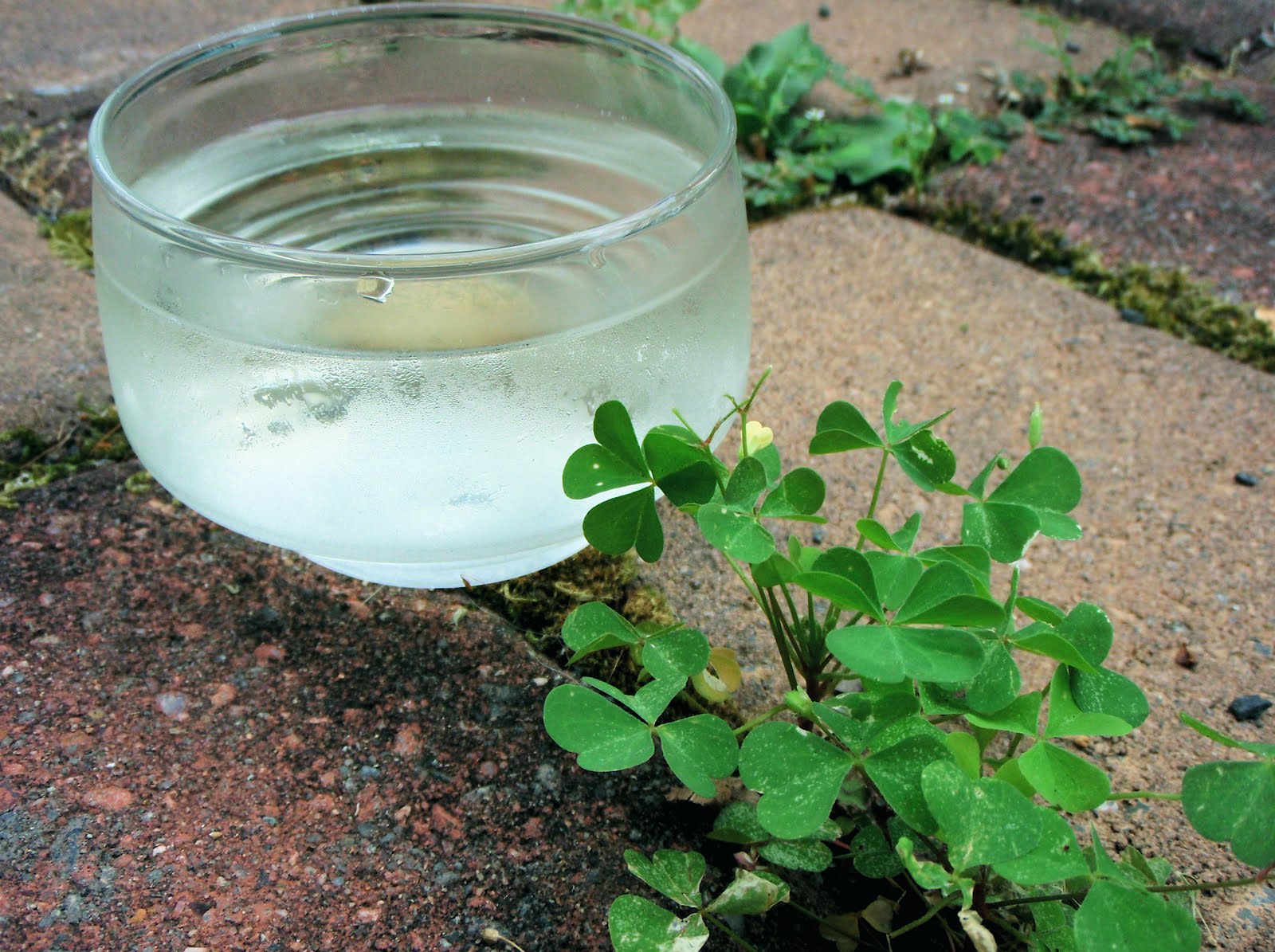
The prettiest view of the trip was not a mountaintop vista but a little something I noticed nearly underfoot. Isn't he/she a beaut?
Note: I didn't eat it.
Friday, May 27, 2011
Smoky Cheese, Hemlock Tea and Other Camping Tidbits
Friday, October 1, 2010
Weed Tea
I threw together this witch's brew when I was up in Vermmmont over the summer. Rather than drink one of the dubious herbal teas (think "natural" ingredients) someone had left in our cabin, I just went out to the lawn.
There I found plenty of wild edibles just waiting to be steeped in an old coffee pot and drunk by an amateur forager/food writer. These included raspberry leaves, plantain, red clover blossoms, oxalis (aka wood sorrel) and bee balm.
It was a little minty from the bee balm, a little tangy from the oxalis, it was made richer by the plantain, and the red clover blossom and raspberry leaf did absolutely nothing except make me feel good about myself for knowing I could use them in tea. I'll have to try both on their own to understand their deal.
Was it the best tisane I've ever had? If you said "yes" you clearly haven't read my post entitled "The Best Tisane I've Ever Had." But it was great, it was free, it was wild, it connected me to the Earth and made me grateful to be somewhere where I could trust the safety of the wild edibles. (I'm not afraid of the plants, I'm afraid of the pesticide.)
But best of all, it didn't have "zinger" in the title.
Also, sorry to disappoint any stoners who were expecting a post on tea made from marijuana. In case I ruined your high, here's a picture of a Grateful Dead bear to cheer you up again:
Monday, September 13, 2010
Navajo Tea Source
If you'd like to try Navajo tea, and in case you missed this in the comments, Darren has stepped forward as a source for the Southwest Navajo tea that grows wild in grazing land near his home. To buy a bundle, you can email him at ddamon871@gmail.com.
Tuesday, August 3, 2010
When Life Gives You Herb Blossoms...
.... make herb blossom water. Sounds delicious, doesn't it? No. It sounds like nothing. But an infusion of basil and mint blossoms is ethereal, cooling, and a good way to use up part of the plant that you're supposed to remove anyway.
They say that pinching the blossoms from herbs makes the plant redirect it's energy into producing more of what you want: fat, juicy, aromatic leaves. I've never tested an unpinched herb plant against a pinched one, so I can't speak from experience about the effect on your harvest, but going out and removing the blossoms every few days gives you a fun little job that makes you feel like what you do in the grand scheme of things is important: I pinch the flowers off of the basil plants, therefore I am.
But what to do with those decapitated blossoms? Keep basil flowers in your pocket and they'll make your keys smell nice, but they'll turn black. Keep them in a pitcher (or glass) of cold water and their oils will wend their way about the water molecules, imparting a fresh and slightly sweet taste to the drink.
Another interesting test would be this cold brew versus a hot steep. My guess is that, as in cold-brewed coffee, this eliminates any trace of bitterness. Unless you're a pollinator.
Tuesday, July 20, 2010
Sumac Agua Fresca
If your soul screams for yet another post about a sour tea made from wild ingredients, read on. If you'd rather read about designer cupcakes, might I suggest another food blog.
To begin, let's play a little game of word association. I'm going to say a word, and I want you to think of the first word that immediately jumps into your mind. Ready?
Me: sumac.
You: POISON!
But have no fear. The only similarities between poison sumac and regular -- or "delicious" -- sumac are literary. Though they share a name, they look nothing alike.
And yet a hairy, red, seed-studded head of common sumac just doesn't look like something you'd want to eat. And it isn't. But it is something that you want to drink. Simply muddle a ripe head in cool water, let stand for about ten minutes, strain, and drink. The resulting liquid should be a shade of salmon that can only be described as "lovely." It is to pink lemonade as manna is to food.
Besides za'atar, this simple drink is my only experience ingesting sumac, though I could easily imagine a sumac syrup splashed into champagne, among other possibilities.
Though I have little desire to experiment given the quality of sumac tea and the ease with which it is made. Sumac tea is tart and fruity, part citrus, part berry. It is a dead ringer for a splash of pure cranberry juice in water, which is something I drink all summer but will never need to pay for again. Sumac-ade, as it is often called, is just as good if not better, not to mention carbon-neutral and obtainable without the exchange of currency. Nor does it come in a wasteful container; I carried mine home in a hat.
Brewing a cool, refreshing glass of tangy sumac jus doesn't even require a heating element, and the process could therefore predate the invention of fire. Forget about so-called organic food flown in from China: this stuff is the essence of sustainability.
----------------------------------
Sumac Agua Fresca (aka Rhus Juice)
serves 6
Ingredients:
1 quart of water
1 ripe sumac berry cluster (dark red, picked in mid-summer to fall)
To test a berry cluster for flavor, gently rub it and then lick your fingers. They'll taste tangy if you've got a winner.
Twist or snip off the berry head. Thoroughly muddle it in the water using a wooden spoon or your fingers. Pour through a fine strainer or cheesecloth removing all seeds and hairs, which can irritate the throat.
Sweeten if desired. Serve room temperature or cold. Connect with nature.
Friday, July 9, 2010
Backyard Iced Tea
The Times' article about the Danish chef who incorporates wild edibles into haute cuisine made me feel three things: hungry, ecstatic, and irritated.
Hungry because I want to eat "pulp of air-dried sea buckthorn with pickled rose hips." Ecstatic that an international star chef is making his name by cooking with undomesticated flora. Irritated for the same reason.
As much as I loved the article, I wish we lived in a world in which it wasn't news. I wish that using the free and compelling ultra-local bounty of the natural world was the default, not a bold move that attracts the attention of the press.
I've said it before and I'll say it again: eating wild edibles is a sublime experience. A bite of your environment will shower you with oodles more terroir than wine from thousands of miles away. It will surprise and delight your palate infinitely more than, say, a potato. And perhaps most importantly, it will give you a glimpse of the interconnectedness with the natural world that used to fuel our existence as a species. Which, if you're spending your free time reading a blog, chances are you could use.
The food world is so gaga for novelty, and yet new and exciting tastes abound right under our feet. Everyone (including me) made such a big stink when black garlic hit the scene, but what about the weeds in your lawn? There you're almost guaranteed to find clover, plantain, poor man's pepper, dandelion greens (and flowers and roots and buds) and chickweed, all delicious, all compelling, all free. You'll also find the source of one of my favorite wild teas: oxalis.
This morning I started the day with an ice cold glass of oxalis tea. Oh, you've never had it? Funny, it grows everywhere, it's as easy to make as microwave popcorn, and it tastes totally crazy.
Oxalis tea is a refreshing summer drink with a surprisingly citrusy twang and just a hint of vegetable funk. Pick oxalis from anywhere that you trust. Oh, you don't trust your own lawn because you spray it with toxic chemicals? Hmm, maybe you should think about that. Boil water. Steep a handful of fresh leaves and stems in the hot water for about five minutes. Strain. Cool. Drink. Call the New York Times.
Monday, July 5, 2010
Navajo Tea
While visiting friends on the Navajo Nation a few years back, Elise and I were given a gift of some Navajo tea. When we got home, I stashed it in the back of my tea cupboard where it would stay preserved in the cool and dark. Which also meant that I would forget about it for a couple of years.
Though this video shows one bundle making one cup of tea, we were told that it would yield about fifteen cups, and so we had to wait an additional few months after rediscovering the tea for a time when we had enough guests to drink it. That turned out to be Elise's birthday. Though techniques vary, we tried pouring a pot of boiling water over the single bundle in a large, ceramic mixing bowl and letting it steep for about ten minutes.
The tea was wonderful. I know it might seem fairly obvious to describe a tea that is essentially dried grass as "grassy," but it was. There was a faintly sweet flavor and an aroma like pungent hay. The liquor was thicker than with most true teas, the color a rich gold.
It is difficult to discuss this tea without hyper-romanticizing the West. So permit me the following: the tea was an expression of the land it had grown out of, and in it you could taste the bare rock, sand and sun-baked wood and herbs that struggle to lay claim to a spartan landscape. Talk about terroir.
To me, this tea is about as sacred as food can be. It was a gift, it is a traditional and culturally relevant food, it has medicinal qualities, and, being a wild crop, the tea was foraged and not cultivated, which means this species has been relatively uninfluenced by our presence on the planet. Compare that to something you might find at the supermarket. Orange juice with fish in it, for instance.
The funny thing is that when we were given the tea we were drinking instant Folger's from a big, red plastic tub. I don't want to give the illusion that most Navajo are out foraging for their food. Like any rural, low-income community, most of their food is store bought and highly processed. But when the conversation turned to traditional crops, our friend went into his pantry and brought out a Ziploc bag bearing three hand-tied bundles of the wild tea.
It was inspiring to see such a traditional food still earning a place on the shelf next to products that are engineered to be addictive and are marketed with millions of dollars. But the best part is that I still have two more bundles.
Tuesday, August 18, 2009
Links Galore, Links Galore
I've received a few link exchange requests recently, and it's often difficult to tell which are from actual people and which are from capitalists. I'll let you figure it out:
Kalahari Tea: an eco-friendly, organic tea company that sources raw materials and products from South Africa to support the local economy. Their tea bags are made of unbleached hemp and wood chips, they contribute to the African Wildlife Foundation and are members of 1% for the Planet (which is about the environment, not milk).
The Teacup Tango: I received this tea-themed music video from a wife and husband duo who created it to win a scholarship competition. From their experience they have concluded that "Tea is awesome and there is so much more to it – whichever type you prefer – than we ever realized."
I highly recommend watching it. FYI, my favorite moment occurs at 50 seconds in.
Friday, July 3, 2009
The Best Tisane I've Ever Had
Expletives and herbal tea don't often go together, but I'm pretty sure I muttered one after taking a sip of this after last night's dinner. Made from freshly plucked anise hyssop and cilantro flowers, it was the best tisane I've ever had.
For those who poo-poo herbal tea in favor of true tea, know that equally complex flavors are possible from plants besides camellia sinensis. I didn't fully believe it myself, but this tea was the most powerfully flavorful thing I've put in my mouth this year.
Like garlic scapes, the flowers of herbs are a double boon. A culinary asset on their own, removing them also make the parts of the plant that you really want to eat (the bulb of the garlic and the leaves of the herb) more productive. The flowers of the anise hyssop were a shade of purple that would look at home in a Monet, but once hit by the hot water they became pale. I took comfort in knowing that the purple was now somewhere in the liquor, and that I drank a color.
The hyssop is incredibly sweet and of course very licorice like, and the cilantro flowers are, unsurprisingly, a very floral incarnation of the already cool and lovely cilantro. Together the two were sweet and deeply aromatic with just a hint of savory, no stronger than an association.
We spend so much time comparing the flavors of tea and wine to other things like flowers and herbs. So why not go straight to the source and just drink the flowers and herbs?
Or, as a friend of mine one said, if people want things to sell like hotcakes, why not just sell hotcakes?
Wednesday, May 27, 2009
Stone Tea
Some people dream of owning a house on the beach, but I've always aspired to throwing a rock into a fire and then using it to boil water.
Last weekend, I achieved that lofty goal while camping on the Cape for Elise's birthday (we saw a seal!). Right on cue, heavy mist rolled in as soon as we crossed the Sagamore, and a roaring campfire did wonders to lift our spirits and dry our clothing.
I had a bit of a sore throat and, desperately wanting a cup of tea, I missed the creature comforts of a home kitchen. But then I realized that I had everything I needed right around me. I filled a steel travel mug with freshly snipped pine needles and water, then tossed a walnut sized stone into the blaze.
After about ten minutes, I removed it with a spoon, still glowing, and plopped it into the mug. The water immediately began to boil with fine bubbles reminiscent of a Guinness, which you can see if you look carefully at the above photo. For a strainer, I used my teeth.
The vitamin C-rich pine tea soothed my throat, and I was proud of having made my dreams of a cuppa come so thoroughly true. From now on, anytime I have a fire, there's going to be a stone in it and some tea in my future.
So it wasn't oranges with rosemary and sugar, but it still hit the spot.
Thursday, March 19, 2009
For Mate Morons, More On Mate
After my last post on mate (the tea, not the romantic partner), I received a stern rebuking from my Chilean mate muse. He had this to add:
There are some points that could help you to improve your mate (not matƩ):
Aclaración: the idea is the leaves are getting wet from the bottom to the top. You said that you must cover the leaves with cool water... that's a mistake: you musn't cover it. You have to put in the water and try, always, to do it in the same point, in order to keep the top leaves dry: don't spread the water and never cover the leaves. Like that, it'll taste better and it will last more!!!
Not only did I accent the word incorrectly, I also missed out on the whole concept of the water percolating up through the leaves rather than down from above. So from now on, when I drink mate, I'll say "bottom's up!" And no one will know or care what I'm talking about.
I also received advice for brewing mate in a grapefruit, which sounds like a much classier version of smoking pot out of an apple. Eli wrote:
Make mate in your grapefruit. Delicious:
1. Hollow out a mate-sized hole in a grapefruit. Leave a thick layer of flesh on the bottom and sides. (You can still use the grapefruit scraps.)
2. Fill the void with yerba, leaving about an inch of space at the top.
3. Pour a little cool water down one side and slip the bombilla in (to keep the yerba from scalding).
4. Your mate is now ready for hot water, sir. Heat the water until it gets noisy, but don't let it boil. As you refill the grapefruit, squeeze it a little to flavor your delicious mate.
Is anyone else doing anything crazy with your mate that we should know about? (Again, that's the tea.)
Wednesday, March 11, 2009
MatƩ Weather
It's a gray day, no longer winter, not yet spring. Is it warm? Uh-uh. Cold? Ish. On Sunday it was sixty degrees, on Monday it snowed three inches. If Macbeth were here he'd surely proclaim it "foul and fair" (Act I, sc. III).
When it's that hard to get a fix on the weather, nothing feels better than suddenly deciding what it is you want to eat or drink. I imagine this is how some women (or men) feel when they know exactly what shoes to wear. Today, I slid my feet into some warm matƩ.
The world outside is muddled, but in my apartment I'm drinking matƩ, and everything is warm and clear. Like the final act of a Shakespeare play, just one sip turned chaos into order.
I'd dabbled for a few years, but it wasn't until last summer that a Chilean friend fully inducted me into the cult of matƩ (not to be confused with the matƩ cult). Whenever I drink it I dutifully practice his method, and now so can you.
How to Make MatƩ Like Gabriel Sepulveda:
1. Fill the gourd halfway with yerba matƩ leaves. (You could use a less exotic vessel, but you could also drink champagne out of a rusty tin can.)
2. Shake the gourd with your hand covering its mouth, then blow off the dust that gathers on your palm. Repeat until there is no more dust.
3. Gently insert the bombilla (metal straw) into the leaves at a 45 degree angle. Never move it.
3. Cover the leaves with cool water.
4. Fill with near boiling water (between shrimp eyes and crab eyes) by trickling it down the straw.
5. Let steep about four minutes. Drink!
6. Continue filling with hot (but not boiling) water for several more infusions.
Friday, February 20, 2009
Happy (Tree) New Year!
I just wrote an article about Tu B'Shevat, a holiday which is known as the Jewish Arbor Day and the new year for trees. The date coincides with the blossoming of the first fruit trees in Israel, a fact which is hard to register given how numb my hands are as I type due to the eleven degree windchill that I just walked the dog in.
My Tu B'Shevat menu synthesized Middle Eastern fare, Israeli tree crops, and local, seasonal New England foods. Every dish contained at least one ingredient from a tree, even if it was just cinnamon. For instance, sweet potatoes glazed with palm sugar, naan with carmelized onions, goat cheese and dates, and banana cream pie.
For those of you who object because the banana is not a true tree, don't worry, the pie also had lemon curd. We washed it all down with hard cider and pine tea, both tree products and both locally made/foraged, even now in the dead of winter.
While it might seem strange to celebrate spring in winter, there is a convenient connection for those who wish to find a relevant, tree themed event currently happening in the U.S. Here, Tu B'Shevat also marks the start of maple syrup season.
Coincidence? Yes. See here for the article.
Thursday, January 15, 2009
Teatulia's Tulsi Tea
I've had a few readers complain that Tea and Food is much more food than tea, and they're right. One reason is that it's more important to eat food than drink tea, so one tends to overshadow the other.
Another reason is that I might focus on the same variety of tea every day for a month, but I'm not going to blog about it more than once. But rest assured that when I try something new, unless it's Lipton French Vanilla, you'll hear about it. For instance, Teatulia's Tulsi Infusion Tea.
You might recall Teatulia (then known as Tetulia) from my two-part post back in June, but if you're too lazy to click on the hyperlink, here's the short version: they're an extremely socially and environmentally conscious company, and they make great tea. Support them.
This morning I finally had the chance to try their flagship blend, an infusion of the Ayurvedic herb tulsi with their standard black tea, both sustainably grown. It's a tea unlike any other that I've tasted, and its unusual flavors drew me right in. Tulsi is also known as holy basil, and in some parts of India it is considered to have almost magical properties, as this excerpt from the blog Health is Wealth will attest:
A few leaves dropped in drinking water or food-items can purify it and can kill germs. Even smelling it or keeping it planted in a pot indoors is said to prevent the whole family from infections, cough and cold and other viral infections. It has been an age old custom in India to worship it twice daily, water it and light lamps near it, once in the morning and once in the evening. It was, and still is, believed that it would protect the whole family from evils and bring good luck.
On this ten degree day, it certainly did have a warming and uplifting effect that went beyond the usual warming and uplifting effects of c.m. The flavor of the herb was similar to that of the sweetest, most licorice-like Thai basil, and it was nicely balanced with the earthy pucker of the black tea.
There are so many cloying herbal blends out there (again, Lipton French Vanilla), so it's refreshing to taste one that has some real umph. Think I'll go brew a second flush right now.
If you'd like to try some for yourself, see here. And yes, I know I need to oil my cutting board.
Tuesday, December 16, 2008
Sassafras Tea
Sassafras: it's a hard word to spell, but it makes a great tea. And just like any wild edible, it's free, local, and, if you pay yourself for it, fair trade.
I harvested the sassafras that went into this cup under the guidance of Wildman Steve Brill in Central Park, even though doing so has previously gotten him arrested.
The plant, which is responsible for both file powder (leaves) and root beer (root), has the distinctive feature of bearing three different leaf patterns. Harvesting the root does require killing the tree, so make sure you do so where plenty of others are growing (they can't all survive to maturity anyway). Pull it out of the ground, sniff the root, and you'll swear someone just cracked open a Barq's.
This single root made about a quart of tea, and I've been told that I can keep using it for future brews. The flavor is quite rich and reminiscent of caramel, birch, and to be blunt, root beer. In this day and age it's tough to wrap one's mind around the fact that something can taste like something else through natural means.
I'm sure it must be good for you in all kinds of witchy ways, but some refrain from consuming sassafras because of purported links to cancer. However, everything I've read suggests that's only the case if you drink lots of it and are a rat.
Monday, November 17, 2008
Foraging Central Park
This past weekend I was on assignment in Manhattan, trailing Wild Man Steve Brill as he showed a group of New Yorkers things to eat in Central Park that weren't hot dogs. I would never have associated an urban space with natural bounty, but here's a list of wild foods we ate or gathered to prepare at home:
-dandelion greens
-gingko nuts
-curly dock
-persimmons (pictured above)
-Kentucky coffee
-garlic mustard
-wild chervil
-onion grass
-chickweed
-crab apples
-honey locust (the pulp in the pods, a more complex apricot jam)
-sheep sorrel
-black nightshade (berries only!!!)
-sassafras root
-poor man's pepper
-plantain (the leaf, not the banana)
-wild mustard
-lamb's quarters (the plant)
-Asiatic day lilly
-wild mint
After a blustery four hours of snacking our way through the park, my traveling companion and I headed back to Red Hook and made tea with the wild mint. It was extremely pungent, delicious, and remarkably calming. But its best attribute was that it provoked thought, as it's not often that one drinks tea grown in Manhattan.
You might think that foraging is a step backward in our relationship with nature, but if you eat a wild persimmon you'll understand that it's clearly a forward move.
The only reason I'm not gushing further details is that I'm saving it for the article, which I'll certainly post here when the time comes.
Tuesday, October 21, 2008
My Mom Turns 6-Tea
It may come as no surprise that my mother is a tea drinker and my stepfather a punster. So when my mom turned sixty, she was thrown a "6-Tea" party. The task of selecting which six teas of course fell to me. So of course I called Dave.
Together we decided on Shou Mei Classic White, Green Dew Gunpowder, Chrysanthamum Oolong, Keemun (black), and a few cakes of Yunnan Compressed Pu-Erh Tuo Cha, all from Upton. To mix things up I included one herbal, brewed from the needles of a Florida Slash Pine and harvested a few blocks from the house.
We decided to demonstrate the camelia sinensis spectrum, going from white to black. In fact those were the two most commonly requested teas: Shou Mei and Keemun. I'm guessing that's because black and white tea are the most and least familiar, respectively.
I was more surprised by which teas where who's favorite. One of my mom's friends liked the pine best, and one of her friend's teenage daughters favorited the puehr. (And that was even after I described it as "cavey.")
As usual, my favorite was the oolong. The blend was so nicely done that you couldn't tell where tea stopped and flowers began. In other words, it was unlike many blends in that nothing stood out, the two elements being balanced in a compliment that went both ways. Yet it still tasted so much like oolong that I wouldn't have been shocked to learn that the chrysanthemum was just a colorful descriptor, as is often the case with oolongs anyway.
Here's a quick lowdown on everything else.
Shou Mei: pleasant, though extremely mild. There was a faint hint of citrus, but it may have been a trick of the mind as white teas are so commonly infused with citrus these days, probably to make them taste like something. Or maybe it was just because we were in Florida.
Green Dew Gunpowder: Good and aptly named, being as refreshing as green dew and as grounded as gunpowder. That doesn't actually make sense, but the tea was both light and earthy and that seemed like a convenient way to say so.
Keemun: I never drink black tea, but was surprised by how sharp and fresh this one tasted. It might make aficionados bristle to hear an adjective so commonly associated with the dregs of the industry, but it really was "brisk." (Note: if you go to one hyperlink today, go to that one.)
Pu-Erh Tuo Cha: Not as impressive as a puehr can be, but that wasn't the point. This was an easy intro for those who hadn't had a puehr before, which was everyone. Even though I brewed it lightly, many still wrinkled their noses and my mom described the bouqet as "fishy." Elise suggested the more palatable "marine."
In the end a good time was had by all, and everyone left much better equipped to think outside the bag.
Monday, September 22, 2008
Pine Tea Update
One further note on making pine tea. Tonight I used full-on boiling water and let it steep much longer than usual, maybe even twenty minutes, and the result was a much stronger cup. In the past it's been more like a faint essence of pine, but this was like drinking a tree. Any time you find a downed branch in a trustworthy area, go for it and you cannot regret it.
On another note, thanks to everyone who attended my workshop at the Urban Country Fair over the weekend.
Thursday, September 11, 2008
Coca Tea
I recently received a package of coca tea, also called mate de coca, from a Columbian friend in Boston. Depending who you talk to, this tisane made from the plant that, when more seriously manipulated will yield cocaine, is either a big deal or not. As usual, if you consult the internet, it will tell you all kinds of crazy sh*t, like that it has more protein than meat
When I asked my friend who gave me the box whether coca was legal in the U.S., he began rapidly shrugging and blowing out little puffs of exasperated air, as if to say "How would I know what your crazy gringo government thinks about it?"
In my two times drinking the tea, I have felt no effects that should even approach illegality, this coming from someone too caffeine sensitive for anything but the occasional cup of coffee on a full stomach. The tea is mild and smooth, even buttery, with a slightly fruity aroma and flavor. It is said to help with altitude sickness, and friends of mine who have traveled through Peru have attested to its soothing powers in potentially nauseating situations.
Traditionally used by indigenous peoples of the Andes region as a sacred plant with powerful healing and nutritive qualities, the leaves have been found alongside 3,000 year old mummies. Of course it took modern Europeans to refine it into cocaine, a substance that in turn destroyed many of the cultures in which coca originated.
Through the lens of the local food movement, which touts the many benefits of eating foods grown in your immediate vicinity, it would make sense that something that grows at a relatively high altitude is helpful for people living at a relatively high altitude. Similarly, I'm sure the cherry tomatoes growing in my backyard are imbuing me with some special fortitude, though they, too, originated in Peru.
Tuesday, September 9, 2008
Pine Two Ways
Pine tea was one of my first forays into wild edibles, a very old practice now gaining popularity as "foraging" by foodies and bloggers.
Of all places, it happened in Lake Tahoe. Desperate to experience real nature through the "woodsy" veneer of the resort complex I was staying at, I turned to Tom Brown Jr.'s Field Guide to Wild Edible and Medicinal Plants, a fantastic place to start with this sort of thing. It was the following line that made me think differently about something I had only thought of as, well, a tree:
"I know that no matter where there is a pine, my survival is insured."
T.B.J. continues, describing the many uses of pine for food and medicine, including making flour from the inner bark and pollen of male cones, roasting the seeds, and in an emergency situation, boiling the rootlets in two changes of water to eat as a potherb. But it was his description of pine tea that most caught my attention:
"What I drank was an absolutely delicious cup of tea. It was like none I had ever tasted before. It's wild but mild taste seemed to bind us to the forest and to the tree itself. There, part of the natural world became part of our lives."
I looked out the window and saw a young pine directly in front of our (fake) cabin. I snipped a few needles, turned on the hotel coffee pot, got out my toiletry scissors, and got to work. Within minutes I was enjoying my first cup of pine tea. When my dad walked in I proudly offered him some of my wild beverage. Though he asked if it was going to kill him, he did try it.
The cup featured above was a gift from the remnants of Hurricane Hannah that blew through Massachusetts last Saturday night. While I drank it I also cracked and ate some roasted piƱones I got at the the headquarters of the good folks at pinenut.com - more on them later.
This tea was one of Tom Brown Jr.'s first wild edibles, and thanks to him, it was mine too. I highly recommend it as a gateway foraging experience.
--------------------------------------------------------------------
Recipe: Pine Tea
Cut a handful of green needles from any species of pine, or wait for a storm to blow a branch down for you. Heat water almost to boiling. Snip the needles using scissors into a tea cup or heat resistant glass jar. Pour the hot water over the needles and let steep about ten minutes or until you can see that the color from the needles has gone into the water. Strain through a FINE strainer (I used a bandanna). Compost the needles or return them to where they were gathered, thereby "closing the loop."