There is only one word to describe the cinnamon-chili braised brisket I recently made: "uf."
Though I've used a Jewish word to describe it ("uf" is as Jewish a word as "Jewish"), this one was not cooked with tomato paste, carrots and the other accoutrements that so often accompany this cut of meat when served by members of the tribe. This brisket was a little smoky, a little spicy, a little sweet, and a lot delicious.
It was a Southwestern fantasy brisket, perfect for a day of watching Southwestern fantasy movies. My friends and I holed up for a Sergio Leone movie marathon, and as we've learned before, braised meats are a movie marathon's best friend; just thinking about it makes me want another pork butt pancake.
I like to think that I did for brisket what Leone did to the Western: I took something already very good, ignored genre, added some foreign flavor and weird music. So maybe I didn't add the music, but it did come in later.
Three days before I defrosted a three pound hunk of locally raised, grass fed beef, which by the way cost as much per pound as "natural" supermarket meat (about ten bucks). I believe that we should all be cutting down on our meat intake, but I also believe that there is nothing quite like an enormous piece of raw meat to stir one's blood. Quinoa just doesn't have the same effect on me.
As I prepared the meat my dog wandered in with a dazed look on his face, like he was getting a contact high from the aroma. I made him a little dog agua fresca by pouring the juices from the bag into his bowl.
Neither he nor I could leave the kitchen while the meat was around. I tasted a piece of it raw. I tasted a piece of it seared and unseasoned: pure cow. And then it disappeared for several hours into a dutch oven inside of a non-dutch oven. I could have done it in the crockpot, but this way the radiant heat from the oven would also warm the house, killing two birds (and one cow) with one stone.
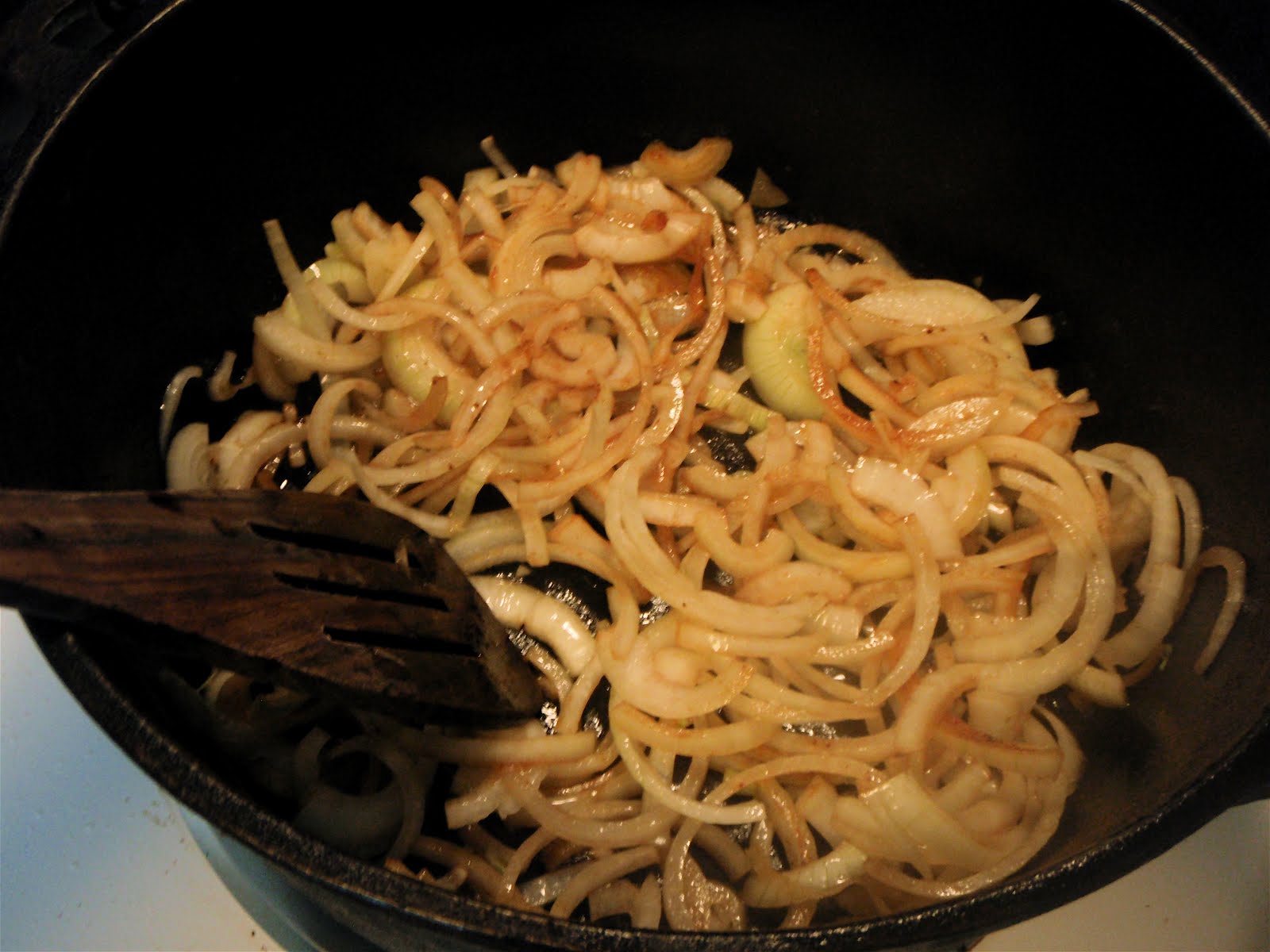
For spices I used cinnamon, whole dried chiles and black peppercorns, chipotle powder, an absurd amount of cumin that still wasn't too much -- when have you ever thought "this has too much cumin?" -- some coconut sugar and cider vinegar that was still fermenting, so somewhere between cider and cider vinegar. It simmered with all of the above plus a little water and several seriously browned onions.
After a few hours in the oven-within-the-oven, the meat had become tender and the liquid, onion and spice mixture reduced to fantasy beef candy. I pulled the meat, keeping the strands as long as possible (I love brisket for that -- meat noodles) and put it back into the pot to marinate for another two days with all of the goodies.
During one of the Leone movies we reheated it and then ate it on slices of Iggy's with sprigs of cilantro and a little smoky bean dip I'd made as well.
And then the weird music did come in. It was the squealing of our ecstatic stomachs.
Uf.
Tuesday, November 9, 2010
Cinnamon-Chili Braised Brisket
Monday, September 20, 2010
Quote of the Day
From Monbiot:
"If pigs are fed on residues and waste and cattle on straw, stovers and grass from fallows and rangelands – food for which humans don’t compete – meat becomes a very efficient means of food production."
Wednesday, April 28, 2010
What I Ate in Hawaii, Part 2
If my previous post on poke led you to believe that all Hawaiian food is sunny and light, allow me to introduce you to plate lunch. If Hawaiian foods were Lord of the Rings characters, poke is an elf, plate lunch a cave troll.
Poke says "welcome to Hawaii!," places a lei around your neck and fans an ocean breeze in your direction. Plate lunch slaps you a little too hard on the shoulder so that you fall down in the sand and just take a nap instead of trying to stand back up.
I only ate plate lunch once, so I may not have the most accurate take on it, but as I understand it, a plate lunch is a heavy dose of meat, usually pork, a few scoops of white rice, and a seemingly misplaced side of macaroni salad.
It took three of us and one two year old to finish a plate lunch combo with both Kalua pig and lau lau at a place called Keneke's in Waimanalo. The amount of meat, especially for the price, was either astounding or disconcerting depending on whether you're thinking about your stomach or the rising temperature of the planet. Certainly no one needs that much meat in one sitting, but I certainly loved eating it.
The Kalua pig was a juicy mound of smoked, shredded pork. Exactly what the seasonings were I can't say, though salt figured prominently. The lau lau was pork wrapped in lu'au leaves which where then wrapped in taro leaves and steamed. (Apparently lau lau often contains butterfish as well, and though I didn't see any in there, I will get to butterfish soon.) The pork was about as tender as could be, the lu'au leaves rich and deeply flavorful, like a cross between spinach, calaloo, and pure iron.
My understanding is that these dishes were traditionally cooked in an imu (underground oven) and are now more commonly prepared by steaming on the stove top. Again, refer to Rachel's book if you want to know for sure. All I know is that it was delicious.
Tuesday, March 23, 2010
Pork Butt Pancakes
Last weekend my good friend Ian hosted a Tarantino marathon in the home theater he built in his basement. With so much blood and guts in our immediate future thanks to films like Kill Bill and Deathproof, we had a hankering for flesh, and so we braised a pork butt as the films rolled.
A movie marathon is a perfect opportunity for the lengthy braising of a large piece of meat: you have time and you have mouths. Ours started at 10am, at which point Ian made pancakes and we started the butt in the crockpot with just itself, the spices below, salt, and a splash of cider vinegar. By dinner time the meat was tender and juicy and fragrant with cumin, pimenton, coriander, chiles and cinnamon (and some palm sugar to help bring it all out).
Between films we peered through the fat dappled glass lid of the crockpot to watch the bone rise up from the meat, which slid into the hot bath that awaited it at the bottom of the pot. The garlic cloves we'd stuffed into little slits popped out like eyeballs wrenched from their sockets by an angry Beatrix Kiddo, and the scent of the simmering meat was as sweet as the taste of revenge. Unlike revenge, the dish was best served warm.
We were planning on having the butt on buns, but Ian had extra pancake batter and so he prepared another batch. It turns out that pulled pork on a pancake is one of life's finest offerings.
The fluffy pancakes and the succulent pork made for as delightful and unexpected a pairing as a kung fu fight scene with a Sergio Leone soundtrack. And yet there was something familiar about the combo. Was it a previous association from pancakes and bacon? Or the semblance of a hand held pancake full of pork to a taco?
I don't know, but I do know one thing: I wish every day was filled with pork, pancakes and pictures.
Tuesday, March 9, 2010
Short Ribs Come Up Short
Meat has never been more popular and unpopular than at this point in time. Its aficionados are more rabid than ever -- from fat crazed foodies to members of developing nations who are upping their intake -- and the same fervor is found in those who abstain. Depending on who you talk to, eating meat is either the pinnacle of human existence or the rope we're hanging ourselves (and the rest of the planet) with.
I fall somewhere in between. I love eating meat, and I recognize how bad it can be in the amounts we eat it and in the way we produce it. When I do partake of the flesh, I mostly eat sustainably raised meat from nearby farms like Codman and Stillman and Verrill and rarely let it take center stage on the plate. That keeps me below the national average of a half a pound a day, which if you're going to eat meat is really the least you could do.
Of the popular cuts of meat with those for whom meat is popular, short ribs are currently tops. They meet all of the criteria for hip meat: they're fatty, popular in Asian cuisines, and most importantly not something most of us grew up eating. (And by "hip meat" I mean meat that people are into, not meat from the hip.)
I've been perfectly happy eating short ribs in the past, though I've never thought they were any better than any other fatty cut that's been braised forever in something delicious. But when I finally made my own short ribs (by which I mean short ribs that I cooked and not part of my body), I was a little let down.
Largely it was my fault. I went with a generic dark, Chinese-ish sweet soy braise, and I went overboard with cleaning out my cabinets to flavor it. Components included leftover coffee, Sichuan peppercorns, a star of star anise, cider, palm sugar, soy sauce, a cinnamon stick, carrots, onions, garlic, cumin, I think, as well as the belief that I had the power to haphazardly create the perfect braising liquid. That last ingredient was probably the one most responsible for the slightly bitter aftertaste.
Also, there was just too much fat. I'm not celluphobic, but I also will only eat so much beef fat in one sitting (by which I mean not a lot of beef fat rather than SO much [emphasis mine ((everything else mine too))]), and there just wasn't a ton of meat left after I'd separated it. But note the juice being absorbed by the board.
And just to make sure that the meat wasn't the main event, it was served with broccoli and some of the reduced liquid over quinoa-corn noodles.
Now I know what you vegetarians and vegans are thinking: why not just eat the noodles and broccoli? Well that wouldn't have made a very interesting blog post now would it?
Thursday, March 4, 2010
Redbones Beef
Last night I spent ten bucks at Redbones and had as good of a gastronomic experience as can be had for that amount of money anywhere in the "first" world. More on that in a moment.
Dave and I split a pulled pork sandwich which we slathered with as much of their hotter bbq sauce as they would bring us, a mug of pot likker, hush puppies, and unfried hush puppies, also known as cornbread. To wash it down we ordered pints of the current cask-conditioned ale offering, which happened to be a porter from Opa-Opa (I think it was called Vanilla Oak, though thankfully it tasted like neither).
In that litany there was nothing not to like. The pork was smokey and juicy. The pot likker murky and faintly sweet (turnips?). The cornbread was thankfully devoid of sugar. My only complaint is that the hush-puppies weren't as crackly and fresh out of the oil as you want them to be.
The beer was just perfect, and perfect with that food. As I brought the glass to my mouth all of my senses told me that there was something very different about it, which is of course exactly what I want from something cask-conditioned: the head was more dense, the carbonation more silky, and I was more buzzed (either because of a higher alcohol content or because it was the first alcohol I've had since getting sick last week, or maybe just because I'm a nancy.)
The only thing I didn't like about Redbones is the same gripe I have with most restaurants in general. The menu in no way acknowledges the progress that has been made in understanding our bittersweet relationship to industrially produced food.
The latest estimate puts food-related illness costs at $152 billion, and I guarantee that most if not all of those costs come from the same industrial agricultural processes that we think are so cheap; that made my meal last night so intoxicatingly affordable.
So would it kill restaurants like Redbones to throw out even one sustainable option for those of us who want to have our meat and eat it too? River Rock ribs, perhaps?
All the nancies like me would gobble it up.
Friday, May 15, 2009
Meat Thing
Inspired by Melissa Clark's piece in the Times a few weeks back, I decided to make some free-form sausages. Or rather I continued to make highly flavored mounds of ground meat like always, but now thought of them as sausages.
I went with the Merguez or cigar shape, though it might be compared to something else by a middle schooler. Using ground beef from Codman, I mixed it with almost equal parts onion, plus salt, pepper, and loads of pimenton. We were going to grill them over wood, so the smoked paprika might have seemed redundant. But who doesn't want meat to taste smokier?
It worked. They were so good.
Thursday, May 7, 2009
Quote of the Day
From a recent NYT article on inventing new pieces of meat:
"In one tenderness test, researchers cooked muscles to medium, punched out half-inch plugs of meat and set them in a machine that measures the force it takes to shear them in half. Promising cuts were given names like the Sierra, the Western Griller and the Petite Tender."
Tuesday, March 24, 2009
I Heart Lamb Heart
I have a friend whose meat CSA has a cooler full of $1 parts such as hearts and tongue. Clearly they haven't gotten the memo about offal.
Like lobster and countless other foods that were once thought of as edible when necessary, offal has gone from rags to riches. To get a sense of the popularity of these non-meat cuts of meat, just google "the offal truth." That gives you a glimpse of how much it's being talked about, plus it's fun to see how many people thought that they invented the (admittedly clever) phrase.
But back in my world, two lamb hearts still cost a dollar. I adapted a recipe from Nose to Tail and braised the hearts on the stovetop with a cornbread stuffing (and by "adapted" I mean "left out lots of bacon").
The stuffing and the braising liquid were both the results of some serious scrounging. Ingredients included over-fermented cider and chopped up bits of Tom-Tom Turkey Sticks. Before there were in-sink-erators, there was braising.
Besides timidly nibbling chicken parts in gravy, these were my first real hearts. I won't share the recipe since it wasn't an unmitigated triumph, and the next time I'd probably try roasting or oven braising. But they did turn out well and I'd eat them again. The texture was quite nice - between steak and liver - as was the appearance. Sliced into cross sections, the stuffed chambers made for an attractive semi-spiral.
Also, cramming the stuffing into the heart provided a good visual aid for what it might be like to eat too many fatty foods.
Thursday, March 12, 2009
Buffalo Yam Chili
Like some of my all-time favorite dishes, this one just came to me out of the blue, like a buffalo thundering across the prairie and then into my pot.
I'd never heard of chili with yams (or pineapple vinegar) before, but the spirit moved me to unite these unlikely but not unfriendly ingredients. It turned out to be the best chili I've ever had. I'd be tickled for others to take up the gauntlet, and if you do make it, drop me a line and let me know how it turned out.
There are three reasons as to why it was so good. The first was the choice of ingredients, especially the spices. For those still using "chili powder," I strongly suggest creating your own mix. You might find that you prefer more cumin, or less partially hydrogenated oil and silicon dioxide, all of which are commonly found in the pre-made stuff.
I went heavy on whole cumin seeds and chipotles, and their smoky heat paired beautifully with the sweetness of the yams, while the buffalo kept it grounded.
A word on buffalo. Yes, I used buffalo, like a buffalo, not like a buffalo wing, which is chicken. Some might balk at the idea of eating a buffalo, and if you're ethically opposed to eating meat, then I understand where you're coming from. But if not, and you just can't stomach the thought of eating an animal that doesn't appear in a white kid's barnyard animal picture book, I have no sympathy for you, and you don't deserve to eat this anyway.
Also, from what I understand, buffalo don't tolerate confinement, and so raising them in a CAFO is not (yet, I'm sure) an option. Therefore any buffalo meat, even if it's in an otherwise ecologically disastrous chain supermarket, is technically free range, for what that's worth, which is something. As the NYT reported in '07:
"A meeting of people who raise buffaloes is not at all like a meeting of people who raise conventional cattle. For many buffalo herders it is a calling, an effort to save part of their national heritage. They talk of sustainability and even of a holistic approach to raising their animals, which, unlike cattle, are still wild, not domesticated."
Of course you shouldn't eat too much of it, as you shouldn't eat too much of any meat, especially red. Which is why I used a small amount of buff for a big pot of chili, going with the Mark Bittman-Thomas Jefferson approach of using meat as more of a seasoning than a main dish.
The second reason it was so good was browning. Brown everything you put in the pot, from the cumin seeds to the meat. The broth will be richer, the color darker.
The third reason it was so good is that it was chili.
---------------------------------
Recipe: Buffalo Yam Chili
3 yams
1/4 lb ground buffalo
1 large can of tomatoes (or fresh in season, but never these)
2 cups of precooked beans in the pinto or kidney family (or 1 small can)
2 onions
1 red bell pepper
5 cloves garlic
2 dried chipotle peppers
2 tbsp whole cumin seeds
a splash of homemade pineapple vinegar (or apple cider vinegar)
salt to taste
neutral, high heat oil for browning (i.e. canola)
Note: This might seem like a lot of ingredients and steps, but you're only really doing two things: browning and simmering, and you can certainly handle that. Therefore you'll need a skillet and a big pot.
1. Put the tomatoes in the big pot on medium heat.
2. Toast the cumin seeds and chipotles in the dry skillet. Add the cumin to the pot with the 'maters, set the chipotles aside.
3. Cut the yams into bite sized hunks. Seriously brown them in the oil, then add to the pot.
4. Dice and brown the onions. Mince the garlic and add it and the diced bell pepper to the skillet when the onions are at the halfway point. Transfer to the pot when ready.
5. While the onions are in the skillet, de-stem and de-seed the chipotles. Soak in some of the warm tomato water until soft, then muddle (or blend), and add to the pot.
6. Brown the buffalo. Add to the pot.
7. Add the beans, simmer ten minutes, then add salt and vinegar.
8. If it needs more kick, add cayenne to taste. It's good now, but it will be better tomorrow.
Monday, March 9, 2009
Cured Duck Breast à la Ruhlman
In December Michael Ruhlman blogged about how incredibly easy it is to cure your own meat, here and then again here. The original post was entitled "Salt!"
And those are really the only two ingredients you need: salt and enthusiasm.
I couldn't imagine that it was as simple as Mr. MR said, so I decided to test his most basic recipe. I took a duck breast, wrapped it in salt for 24 hours, rinsed it off, and hung it up in a red bandanna not unlike one you might find dangling from the stick of Emmett Kelly.
Pre-salting it looked like this:
Post-salting it looked like this:
The flesh had darkened to a deep, almost purple red, as though somewhat cooked (which is what the salt does). I realize these photos would have a stronger before-and-after effect if I had shot the same side of the breast each time, but I didn't. So shut up.
When the appropriate length of time had passed (one week), I sliced off a piece, giddy with anticipation. It was disgusting.
Elise pointed out that it may have been the way I cut it. If you think of biting into a thick hunk of prosciutto (or prosciutto Americano), you can imagine it validating the too much of a good thing theory. I tried slicing it thinner, a difficult task for someone with knives like spoons. It wasn't bad, which of course means that it also wasn't good.
Once I trimmed the fat (saving it for rendering), I found that a thin slice was quite palatable. Still, it seemed like Ruhlman was right about being able to cure with nothing more than salt, but not about having it be something that you're particularly interested in eating. When I fried some up, all that changed. Crisped in a pan like bacon, the cured duck was extraordinary.
Ruhlman was dead on. With nothing more than salt, meat turns from a ticking time bomb of expiration to a delicious treat that you can keep enjoying from the time you cure it until the time at which you become neurotic about how long it's been since you cured it.
The duck bacon performed best when slivered, crisped in skillet, and served with something of contrasting texture and flavor. For instance, on top of a root veggie mash, as pictured at top.
In addition to tasting great, Ruhlman's simple salt cure provides an extremely low tech solution to making food last. No doubt this is an ancient answer to a problem we now counter with machines that require massive amounts of ill begotten energy.
How convenient that nature provides fixes to its own problems. God made meat that goes bad quickly, but god also made salt. And Michael Ruhlman.
Monday, February 23, 2009
The Tale of Niman Ranch
Brendan here, with a word about meat. If you're familiar with Niman Ranch meats, you probably know that it was recently taken over by Natural Food Holdings, a bigger company not founded by hippies (probably). Bill Niman isn't impressed by what they've done with the place, and won't eat the meat that still bears his name. On the other hand, the company is now showing a profit, for the first time ever. A synopsis of Niman Ranch's founding, rise and buy-out can be found here.
I think people should raise animals the way Bill Niman does. But if you can't show a profit that way, forget about the business. Raise the animals, eat them, barter with them, and find another way to pay the bills.
Sichuan Gourmet in Framingham
Anyone who has meticulously scoured Chowhound for the best Chinese restaurants in Boston (guilty!) has surely heard of Sichuan Gourmet in Framingham. Anyone who hasn't just did, and everyone should go there.
Pictured above is what I couldn't finish from my leftover smoky hot shredded chicken with cayenne. I loved it, but no one who grew up on "barbarian pepper" could ever eat (or digest, I should say) equal parts chili and chicken, which is how the dish is served at S.G.
Zoe's in Somerville is still my top pick for one stop shopping Chinese food (range, price, location, jellyfish), but at Sichuan Gourmet I tasted the single best Chinese dish I've ever had within 416 miles of Boston (the distance to Grace Garden, the best Chinese food within 7,000 miles, the distance to China). That dish was Dan Dan noodles.
The chef had expertly combined sesame, garlic, and chili, all present, none overpowering. The noodles were dressed with the perfect amount of sauce then topped with crispy ground pork, and for the first time I understood why Fuchsia Dunlop is so crazy about them.
While I haven't made a completely exhaustive search of Chinatown, so far I generally agree with the notion that the best Chinese food in Boston lies in the burbs. But if you're like me and Ezra Klein (favorite political blogger!), and you really like Sichuan cooking, go to Framingham.
If you can't make it there, the stuff in Chengdu is probably good too.
Friday, February 6, 2009
Clean Your Plate, And Your Leftovers
For the second time in my life, I recently had take-out food so bad that I actually washed it off to make it better.
The offending dish came from a local Chinese restaurant that, despite its horrific, gaudy exterior, I desperately hoped would be good. I hadn't even thought to eat there until examining the dinner menu while having a (flaming) drink at the bar with some friends from out of town. When I saw the Yu Shiang section, my spirits lifted, or perhaps I was being lifted by the spirits shooting up the long straw from the scorpion bowl. In either case, I decided to go back for dinner, and I'm sorry I did.
I ate as much as I could while at the restaurant, choking down rubbery pieces of meat, the omnipresent (in bad Chinese restaurants) bell peppers, and a thick, cloying brown sauce that seemed composed of equal parts sugar and corn starch. I know that would just be powder, but that's how it tasted.
To make matters worse, while eating I was reading Fuchsia Dunlop's Shark's Fin and Sichuan Peppercorns: A Sweet-Sour Memoir of Eating in China. The contrast between the dishes in her pages and the one before me was depressing beyond the help of any cocktail, no matter how on fire it was. I took most of it home.
There I dumped the slop into a strainer and ran it under water until the sauce broke free and it once again resembled food. I dressed it with nothing but the contents of the two bottles in the photo at top, soy sauce and toasted sesame oil, and the improvement was shocking. The food now tasted more like food and less like the food version of the restaurant's facade.
Still, I'll be going back for cocktails.
---------------------------------------------
Recipe: Washed Yu Hsiang Pork
1 takeout container of bad yu hsiang pork
1 tbsp sesame oil
1 tbsp soy sauce
running water
Dump the "food" into a strainer and hold under running water until the sauce has been rinsed away. Spit down the drain in contempt.
Shake the food until relatively dry.
Dress with sesame oil and soy sauce.
Thursday, February 5, 2009
What My Dog Ate For Lunch Today
A raw goat kidney and kale.
But before you lump me together with people who buy clothes for their dogs, know this: the kidney was from a locally raised goat, it was cheap, I think it's healthy for dogs to eat raw organ meat, and I tried to eat one myself (cooked) but just didn't like it. Also, it was just the ends of the kale.
It seems to have given him the energy needed to chase the splash of light created by the sun reflecting off my laptop, which he is currently doing.
Tuesday, February 3, 2009
Homemade Tortillas
For no good reason, in all of my 28 years I've never made a tortilla. Pita, crepes, pancakes, yes. Tortilla, no. (That last sentence was in Spanish.)
And I still haven't, but last night Elise did, and the results were transformative. If only the standard, suburban "taco night" style dinner would replace packaged tortillas with the real deal, that horrible imitation of Mexican food would become less wooden puppet and more boy. If you then improved on ground beef with "taco seasoning" and shredded iceberg lettuce, so much the better.
But even if you're having DIY burritos or fajitas and you've assembled the world's finest fillings, relying on the contents of that telltale slim ziplock bag for your wrapper can still undo all of your efforts.
Last night I realized that there's nothing like holding a homemade tortilla in your hand. It's durable, yet pliant. Soft, yet firm. It's like holding the hand of a trusted friend, and then eating that hand.
We (Elise) also poached a couple of chicken legs and made a simple sauce with a can of diced tomatoes, dried poblanos, and a splash of the cooking liquid from the chicken. We rolled up the meat from the chicken with a hearty dose of the red sauce and a spear of romaine and were in heaven.
------------------------------
Recipe: Tortillas
From the More-With-Less-Cookbook
(makes 8-11 tortillas)
Combine in mixing bowl:
2 c. unsifted flour
1 t. salt
Cut in with pastry blender (or a fork or your hands):
1/4 c. lard or shortening (we used butter)
When particles are fine, add gradually:
1/2 c. lukewarm water
Toss with fork to make a stiff dough. Form into a ball and knead thoroughly on lightly floured board until smooth and flecked with air bubbles. To make dough easier to handle, grease surface, cover tightly, and refrigerate 4-24 hours before using. Let dough return to room temperature before rolling out.
Divide dough into 8 balls for large tortillas or 11 balls for common 8-inch size. Roll as thin as possible on a lightly floured board, or between sheets of waxed paper. Drop onto a very hot ungreased griddle. Bake until freckled on one side. (Takes only about 20 seconds.) Lift edge, turn, and bake on second side.
Monday, January 12, 2009
Not At All Vegetarian Broccoli
You might think that it would be difficult to make a vegetable unsuitable for a vegetarian, but it's not. In fact, if you order a vegetable dish at any French, Cuban, or Southern restaurant, there's a good chance that it will have equal parts vegetable matter and pork or duck fat. Is that wrong? Not necessarily.
I sautéed the above broccoli in bacon fat and then finished it off with a quick steam in reduced chicken stock. Before you ask yourself what kind of monster uses two different kinds of animals to make one vegetable, allow me to explain.
First off, like all meat that I make at home, both animal products featured here came from reliably sustainable sources, one just down the road. Second, you'll notice that there isn't any actual meat in the dish, just a couple natural remainders of a meat eater's kitchen: I make stock from chicken bones that I freeze over time, and the bacon fat came from what else but making bacon.
Using animal products as a teaser rather than a feature presentation could go a long way in improving the health of our planet, as many have already pointed out, most notably Mark Bittman. This is especially true when the animal product in question is leftover from a previous dish and might otherwise have been discarded.
I eat meat, but I eat way more vegetables, and in fact many dishes that I cook are either deliberately or coincidentally vegetarian or vegan. Straddling both worlds as I do, I am familiar with the strengths and weaknesses of both camps. But one thing is clear: when you cook broccoli with a little bacon fat and chicken stock, you'll want to eat a whole lot more broccoli.
Thursday, January 8, 2009
The Thaw
Perhaps the only downside to locally raised meat is that much of it comes frozen. Unless you're vegetarian, in which case it's nothing but downsides.
Personally, I'd rather get my protein from a happy local cow than a soybean grown in Iowa. But this doesn't mean that I possess the forethought to thaw said cow before wanting to eat it. Hence the above photo, which captures my effort to simultaneously thaw and brown a frozen block of ground beef.
Actually, it worked. When one side of the meat-ice was done to my liking, I'd flip it and do the same to the B-side while using the spatula to shave off the finished portion. I continued doing so until the block had disappeared, at which point I turned up the heat, cooking off any remaining water and giving the meat a final toast. This served as the basis for a sauce to go with leftover (and also frozen) lasagna noodles. It was great, it was hearty, and it was local.
If you really want to eat seasonally in the winter, eat food that's as frozen as the hard, cold earth.
Friday, December 19, 2008
Bittman Meets Dunlop
An enthusiastic reader recently equipped me with a copy of Fuchsia Dunlop's Sichuan cooking guide, Land of Plenty, as well the ingredients to get started. He recommended that I start with one of the chicken appetizers. I did, and I can't imagine an easier or more inspiring introduction to the cuisine.
I made Hot-and-Numbing Chicken Slices from the "Four Ways of Dressing Cold Chicken Meat" portion of the appetizers section (p.141). Essentially you poach a chicken and then dress the meat with a highly flavorful and extremely easy to make sauce. It's amazing, and you'd work harder on meatloaf.
Looking at the broth leftover from the poached chicken, I thought back to Bittman's column/post/video on Hainanese Chicken and decided to merge the two recipes. This meant cooking rice in the water from the chicken and serving the meat on top of it.
Really the whole thing is just a vehicle for the Sichuan peppercorn, the flavor of which is often described as "numbing." (Can numbing be a flavor? "Timmy, what kind of ice cream do you want?" "Numbing!!!") In this dish the peppercorns, which are really the berries of the Chinese prickly ash, are lightly toasted before being ground.
Since I don't have a mortar and/or pestle, I used a jar on a cutting board, and it worked fine. While you're toasting the peppercorns, your kitchen fills with a tantalizing and baffling aroma that lies somewhere between juniper and marijuana. Maybe that's why I'm so hooked on the stuff.
-----------------------------------------------------------------------------------
Recipe: Hot-and-Numbing Chicken Slices (ma la ji pian) meets Hainanese Chicken
Adapted from Land of Plenty by Fuchsia Dunlop (W.W. Norton) and Bittman's Hainanese Chicken.
For about 1 pound sustainably raised, cooked chicken meat (about 1/2 a chicken), cooled.
salt to taste
4-6 scallions, white parts only (I used onion)
4 teaspoons white sugar (I used honey)
3-6 tablespoons chili oil with chile flakes
2 teaspoons sesame oil
1/2-1 teaspoon ground roasted Sichuan pepper (I used 3)
Poach the chicken, then cook rice in the remaining liquid.
Cut or shred the meat, sprinkle with salt.
Thinly slice the scallions diagonally, 1 1/2 inches long, to form "horse ear" slices. Alternatively, thinly slice 1 small onion into whichever kind of ear you prefer.
Stir the sugar or honey into the soy sauce to dissolve it, and then add the oils.
Serve the chicken atop the rice and the scallion or onion atop the chicken. Sprinkle liberally with the ground "pepper" and serve the sauce on the side.
Get the munchies, repeat.
Thursday, December 11, 2008
Repurposed Goat
Last night I made these goat shoulder chops from Codman Farm. And by made I mean "screwed up."
With a choice cut I can make a great steak, I do wonders with ground meat and sausage, and I can braise pretty much everything else with excellent results. The common thread is that all three preparations result in tender meat. It's the only way I want to eat meat, when I do. But if I'm in possession of an unfamiliar cut, as I am more and more from buying locally raised meats, and I don't want to slow cook, I'm often stumped.
I had planned to braise these goat shoulder chops for a few hours, but when I saw how tender they were, I decided to broil. If I had trimmed off everything that shouldn't have been there, it might have worked, but as is they were too much of a wrestling match to enjoy. So I got out the crutch and did some low and slow simmering, and the result was a rich, flavorful stew.
For lunch today I browned the remaining meat and bones left over from our picking at them the night before. At the same time I browned garlic cloves and red onion, then added cumin, bay leaves, a whole dried pepper, leeks, and a can of tomatoes and let it go for about an hour.
The bones, fat, and connective tissue that had made these such bad chops made for a great stew.
-----------------------
Recipe: Goat Chop Stew
1 chop per person
1 can tomatoes
1 tbsp powdered cumin
1 tbsp salt
1 tbsp black pepper
1 whole, dried chile
2 bay leaves
2 onions
3 garlic cloves, whole
the juice of 1/2 a lemon
resourcefulness
Note: The only essential ingredients are the goat and tomatoes, the spices are completely variable (cinnamon and clove are excellent with this or lamb).
Broil the goat chops. Try to eat them, get disappointed, and put the remaining scraps away for later.
Brown those remaining scraps in a splash of olive oil along with the onion and garlic.
Add all remaining ingredients, except the lemon juice. Stir once to combine, then let cook on high for five minutes, giving the tomatoes a chance to slightly caramelize. Stir again and reduce heat to a simmer.
When the meat is tender and the leeks are soft (45 minutes in my case), add the lemon juice. Serve over rice.