See here for my latest post over at the Chefs Collaborative blog. I recently attended their "Shrimp and Sazeracs" meet and greet with the folks behind Four Winds Seafood, a sustainable supplier from outside of New Orleans.
If nothing else it whetted my appetite to return for a full meal at Hungry Mother, a Cambridge restaurant that serves Southern food better than most of the food in the South.
My apologies for the poorly exposed photo - it was after a few Tabasco martinis.
Wednesday, February 11, 2009
Sustainable Shrimp
Monday, January 5, 2009
A Complete Waste of Apples
One of the reasons I was excited to move to my current place of residence was the apple tree in the front yard. I can't pin down the variety, but it seems to fall somewhere in the red delicious family. They aren't the best eating apples, but they bake like nobody's business.
So you'd think I would have used them for baking. Nope! I decided on cider, despite the fact that I didn't have any of the necessary equipment or know-how. This was also right before I learned that good cider contains a carefully blended mix of different apples selected for complimentary flavors. Instead, I just took all the scraggly ones left at the end of the season, ran them through my neighbor's juicer, then used a piece of an old pair of pajama pants for a filter.
The flavor was all wrong, the texture somewhat chalky, and I lost a high percentage of the liquid due to the inadequacy of my filtering setup. What would have made loads of fantastic crisps, tarts and pies made less than one wine bottle's worth of cider.
"At least I'll have alcohol made entirely from my front yard," I thought. Wrong again. It went moldy. It was, as the title of this post suggests, a complete waste of apples.
That said, I did dump the cider/vinegar/mold onto the ground by the tree, figuring that it might at least be appetizing to the bacteria which colonize the dirt. In doing so, I performed a rather tradition wassail.
----------------------------
RECIPE: Ruined Cider
Take lots of apples that would be great in something besides cider, and make cider from them.
Incorrectly ferment the cider, rendering it useless.
Wednesday, December 3, 2008
Not So Hard Cider
I'm glad to see that hard cider is catching on again, nowhere more so than in my kitchen. It's by far the easiest homebrew, requiring no special ingredients or equipment and almost no effort. And if you start with good cider, the end result will be just as delicious (and intoxicating) as the $12-a-bottle variety.
The only trick is finding a cider that doesn't have preservatives. If it's been pasteurized, it should still work, but if you can find one that has not been, all the better.
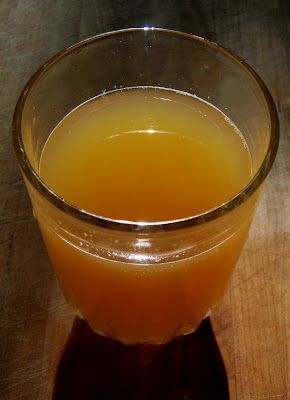
In the past I've let cider go pretty far, allowing most of the sugar to be consumed by the natural yeast to yield a strong, crisp, dry brew. But lately I've been much more into half-fermented cider. I drink it sooner, as a bubbly, tangy, naturally carbonated sort of apple soda. The above photo doesn't quite do it justice, because in real life the stuff has a head like beer.
Maybe it's those friendly, naturally occurring yeasts, but I swear it has a tonic effect in the old fashioned sense of the word. This is the kind of food prep where you "let" rather than "do."
-------------------------------------
Recipe: Homemade Hard Cider
Acquire cider without preservatives, and ideally without pasteurization.
Pour it from its plastic container into something glass, like a large mason jar or empty wine bottle.
Cover the neck of the container with a piece of cloth and a rubber band. A snip from an old (clean) T-shirt makes a particularly fine barrier for dust and fruit flies.
Let sit until it has reached the desired level of fermentation. About a week for the tangy, natural apple soda, two to three for booze.
Monday, October 27, 2008
Re: Hot Buttered Rum
I'll begin my response to comments on the last post by saying that I too love roasted chestnuts, but now love roasted hazelnuts even more.
Leah asked "How could butter and rum taste good together? How I ask you?" In turn I ask her: how could it not?
Brendan writes that "Butter's power to transform good things into fantastic things surpasses its dubious reputation as fatty dairy stuff."
True, though aren't fatty and transformative synonyms?
And finally, to respond to Ezra's questioning my tongue in cheek recipe proportions. See below for the revised recipe, the result of a bathrobe clad conference with my downstairs neighbor just moments ago. (I had to assure her that I wasn't going to make it now, at 10:30am)
But the safest answer to how much butter you want to use is to start small and add "to taste." That way, regardless of how much butter anyone else says you should use, you'll end up using how much you think you should use. I don't like cheesecake, so the best cheesecake in the world is to me still not good cheesecake. The amount of butter in h.b.r. is relative as applied to the general population, but to you personally it is absolute.
And best of luck with braising. May it ease your November 4th-addled brain.
---------------------------------
Recipe: Hot Buttered Rum, Revised
1 shot of rum
1 "restaurant sized" pad of butter
1 tbsp brown sugar
1 dash nutmeg
1 cup milk
Warm, combine, enjoy.
Friday, October 24, 2008
Roasted Hazeluts and Hot Buttered Rum
We're trying to make it to November without turning on the heat, but since campfires are an exception, when it's cold out and I want to warm up I sometimes find myself going outside. As I gently baked in the radiant heat of a recent fire, these hazelnuts slowly roasted on top of it.
While we were enjoying the flames, our downstairs neighbors had appeared out of the darkness with a sack of filberts, so we all got to roasting. Hazelnuts are always good, but I couldn't believe how good they were when thoroughly roasted and still warm. Once cool they still had that toasty flavor, but nothing compares to experience of cracking a hot one.
Sitting in front of a blazing fire on a cool Fall night, it seemed like things just couldn't get any better. Just then, our neighbors reappeared, this time with hot buttered rum.
When I tell people I'm originally from Florida, they always ask why I live in New England. That's why.
------------------------
Recipe: Hot Buttered Rum
Note: There are many frilly recipes for h.b.r. that include cider or ice cream, but my neighbor concocted this minimalist version from memory and it was perfect. Unfortunately she couldn't quite pin it down for me, so measurements are approximate.
Dark Rum (some)
water (a little)
brown sugar (not too much)
nutmeg (a bit)
butter (lots)
Warm it all up in a saucepan, on the stove or the fire. Stir it. Drink it.
------------------------
Food Etymology for Karen:
Filbert: ORIGIN Middle English, "fylberd" from Anglo-Norman French "philbert," dialect
French "noix de filbert," so named because it ripens around August 20, which
is the feast day of St. Philibert.
Monday, May 5, 2008
Think Globally, Drink Locally
Continuing on the epicurean wonders of Ithaca, I am proud to announce that the bar known as Korova now carries the local cider Bellwether on tap. This is a bigger deal than you realize.
For fans of sickly sweet ciders like Woodchuck and Cider Jack, this may not seem like news. However, the U.S. has come a long way since its early days, when cider was the most popular alcoholic beverage. Flash forward to 2008, when you can get virtually any beer you want from any number of far away countries in almost any bar. Our taps read like an Epcot brochure, with brews hailing from such exotic locales as Japan and Jamaica. But cider? Uncommon.
While small craft American beers have made a tremendous comeback in the past few years, cider's popularity has greatly dwindled. I remember touring New England as a kid in 1987, and my dad ordering Sam Adams (in moderation) whenever he had the chance. That's because back then, at least where we lived, the only alternative to Bud was Miller. And brands like Red Dog and Icehouse were still just a glimmer in the eyes of the evil marketing wizards who spawned such tasteless poisons.
But in beer's upswing, our old friend cider has for the most part been left high and dry, in the sense that no one has been getting high from drinking fine, dry cider. Hence my double take when I saw a locally produced cider on tap at Korova.
Since local apples are a whole lot easier to come by than local hops and barley, if you see a cider like Bellwether on tap, you're odds are good that it reflects a deeper kind of local than beer: one which has in it's interests your region's trees.
I'm hoping that Korova's Bellwether tap is part of the larger trend in which Americans are remembering how much better it is to consume things that we ourselves produce. My hope is that real cider will ease into the niche created by brands like Woodchuck as smoothly and effectively as the coyote has taken the place of all the wolves we've killed. In fact, here's my first prediction since coquito: you're going to see a lot more cider. That goes for fancy French cider on wine lists, and hopefully for affordable, local cider at your neighborhood pub.
Only then we can honestly say: "the cider house rules!"