See here for my article in today's Globe on Revolutionary War reenactment cooks:
http://www.boston.com/lifestyle/food/articles/2010/06/30/revolutionary_war_reenactor_loyal_to_the_king_and_authentic_ingredients/

See here for my article in today's Globe on Revolutionary War reenactment cooks:
http://www.boston.com/lifestyle/food/articles/2010/06/30/revolutionary_war_reenactor_loyal_to_the_king_and_authentic_ingredients/
The following is an e-mail exchange between myself and my good friend Andrew Slack of the HP Alliance. The subject is eating lions.
Andrew:
I've said it before and I'll say it again: eating lions is wrong:
http://www.telegraph.co.uk/sport/football/world-cup-2010/7848758/World-Cup-2010-US-restaurant-to-serve-World-Cup-lion-burgers.html
Soooo f*cking horrible.
Me:
If you're not opposed to eating animals in general, why is this so bad? If they're raised (and presumably slaughtered) humanely and are bred in captivity and not removed from the ecosystem that depends on them, why is eating a lion worse than eating a cow? Is it a matter of intelligence of the animal? If so, it may be that pigs are smarter than lions, but it doesn't make news when we eat them.
Andrew:
Look man, you can come at me with all of your "intellect" and burst my self-righteous bubble with "facts" and even expose my childlike hypocrisy and simplistic sense of reasoning with your "brain power" but if I've said it once, I've said it a million times: "I'm totally right in my opinions even if they sound irrational - even if I don't know what I'm saying - I know what I'm saying."

When it's already too hot in the morning, the rest of the day stretches before you like a vast, uncrossable desert. Somehow I know I'll make it to the point when I can lie in bed naked with a fan pointed at me, but I just don't know how I'm going to get from here to there.
Once I have that realization, I can't bring myself to do any activity that would result in even the slightest increase in temperature. Turning on a burner to boil water for tea or oats is out. I'd just as soon turn on the toaster as stick my head in a vat of molten glass Even the warmth generated by the underside of laptop seems too much.
In such weather I often go rabbit. I eat raw fruit and vegetables, often unadorned. (And for some reason I find myself dodging the shadows of hawks). Meat loses much of its appeal.
Additionally, I seek out those foods that promise some cooling effect, by which I mean foods that have an uplifting flavor, such as a lemon, a cold temperature, such as anything out of the refrigerator, or foods whose essences are considered cooling in nature in traditions such as Ayurveda and Chinese medicine. Like corn silk tea.
And this morning, I think I created the ultimate cool food: yogurt, melon, and mint.
Though I don't usually eat dairy, I do make an exception for yogurt during the summer. Why? Because at some point I convinced myself that it was a good idea. The yogurt I used today is, I think, the most flavorful plain yogurt I've ever had: Sidehill Farm, a raw milk yogurt that seems to be a local favorite around my summer residence in the Northampton area (by which I mean I'm living close to Northampton but somewhere cheaper). The melon was a Santa Claus melon. The mint was, I think, spearmint, from the garden.
After a few bites (slurps?) it suddenly felt ten degrees colder. The stuff is as cooling as toothpaste, and just as minty-fresh. It gave me the courage to face the warmth of the laptop.
See here for food historian Rachel Laudan's post on French laws regarding foie gras.
The laws protect f.g. as part of the "gastronomical heritage of France," yet the way the stuff is created (and where it is consumed, which is to say here in the U.S. and everywhere else people have more money than they know what to do with) bears little semblance to "heritage."
Unless of course French farmers of antiquity had machines that could force feed a duck (not a goose) in a matter of seconds?
I know Americans are quick to forget our food history in the face of propaganda from the industry and government and often a combination of the two, but France? Isn't this the country where a mustachioed sheep farmer drove a tractor into a McDonalds while smoking a pipe?

The other night I was invited for dinner at my good friend Sophie's apartment. And a funny thing happened that relates to my career as a freelance writer focusing on food journalism. Because I write about food, Sophie was concerned that I wouldn't like the food.
When people find out that I'm a food writer, they often become self conscious about what they serve me or even what they eat in my presence. I understand the connection, but I'd like to make something clear: food writers like food. In fact, they like food more than normal people.
Unless you're inviting a restaurant critic to have dinner in your restaurant and the also critic happens to have an assignment to review your restaurant, you really have nothing to worry about. Think of a food writer as a baleen whale and food as plankton. We swim around with mouths agape, taking in as much sustenance as possible. To make the comparison even more apt, it occurs to me that I'd happily eat a plate of plankton, which is what we might soon be reduced to anyway.
Sophie and Kailie, another friend also in attendance, made an asparagus, mushroom, goat cheese frittata, which they served with a salad made with greens from Sophie's lush, adjacent urban garden. For dessert, there was a fruit crisp with rhubarb, apples (or were they pears?) and berries. Wine flowed.
Of all people, S. and K. would be the last I'd expect to hesitate when breaking bread with me. The three of us used to work together teaching Shakespeare at a camp in Vermont (the two of them still do) with a bare bones budget, and for lunch we'd frequently find ourselves squatting in a field, eating tuna out of the can and dipping carrots in whatever edible paste-like substances we could find.
That said, they were right to be concerned. The frittata had a little too much goat cheese.
From this article in the NYT:
"Most of the cavemen at Mr. Durant’s gatherings are lean and well-muscled, and have glowing skin. A few wear trim beards. Some claim that they no longer get sick. Several identify themselves as libertarians."

These are the aforementioned tongue gorditas I ate while moving. They were so good that they themselves were quite moving.
Perhaps my all around favorite person in the world of food is author, activist and conservationist Gary Paul Nabhan, founder of the project known as RAFT (Renewing America's Food Traditions). See here for his piece in yesterday's Grist about how the BP spill is affecting precious food sources along the Gulf Coast (and the rest of us who love them).
The gist of it is that now more than ever we need to support those fishermen (and gator hunters) in jeopardy. There's also this to consider:
"Unfortunately, this crisis is not just an environmental one, but a food justice one. The spill is economically devastating to some of the most marginalized ethnic communities in the United States, including Cajun, Houma Indian, "Creole" Black, Vietnamese, Cambodian, and Latino communities in and near the Mississippi delta. And while most U.S. agencies and media have sidestepped this issue, Cuban and Mexican fishermen are just likely as Gulf Coast residents to be have their livelihoods disrupted by the oil spill."

This year I'm on the planning committee for the Stone Soup Dinner, an event that showcases the agriculture bounty of Concord, MA. We kicked off the planning sessions with what else but a pig roast.
I'd had pig roasted in a Caja China (now with bottle opener!) once before, and it was terrible. Not tender, it was kind of like chewing bubble gum that tasted like pork. Which isn't something I'd be adverse too, but eventually I do like to swallow my food. This pig, however, was divine, with tender flesh and super-crackly skin.
As good as the pig roast was, the full scale dinner promises to be even better. If you live in Boston or anywhere else in the Metro-West area, clear your calendar for September 26th. See here for a list of Concord businesses at which you can purchase tickets.
From this Mother Nature Network article:
"Kangaroo is a red meat very similar in appearance to tenderloin that might come from ox."
Oh, ox tenderloin? Yes, I'm sure we're all well acquainted with it.
From the New York Times food section:
"But as miraculous as its biblical apparition may seem, manna is real and some chefs have been cooking with it."
See the full article here.

This dish was born from the happy marriage of long-frozen tortellini and pretty far-gone fiddleheads from the discount rack at my local chain grocery store. Though both had been cast out from society and nearly left for dead, these two orphans found that they were made for each other. And then I ate them.
Since I think of fiddleheads as a wild crop (anyone know if they can be cultivated?), I was deeply saddened to see them imprisoned in plastic wrap and being sold for a dollar a package in that sad clearance section in the produce section. Sharing space with bruised and mealy red "delicious" apples from Argentina were these iconic New England heralds of spring. I knew it was my job to rescue them.
They took a little more debearding then usual, but once sorted cleaned, blanched, and shocked, they looked as good as new. The tortellini was a little gummy from its lengthy cryogenic sleep, but being from the excellent pasta makers at Capone, I couldn't bear to let it go.
I tossed the al dente tortellini with the blanched 'heads in olive oil and a little more balsamic vinegar than you'd think, cracked in plenty of pepper and dusted it with parmesan. It was good. The fresh, crispy, gooey fern sprouts paired well with the firm, chewy, salty pasta. I'm surprised I haven't seen the combo before.
What I liked even more than the excellent flavor was the way the fiddleheads wrapped their tentacles around the pasta, as if to say "we're going down together." It was like eating Romeo and Juliet, which is appropriate since tortellini are said to have been inspired by the belly button of an Italian woman.
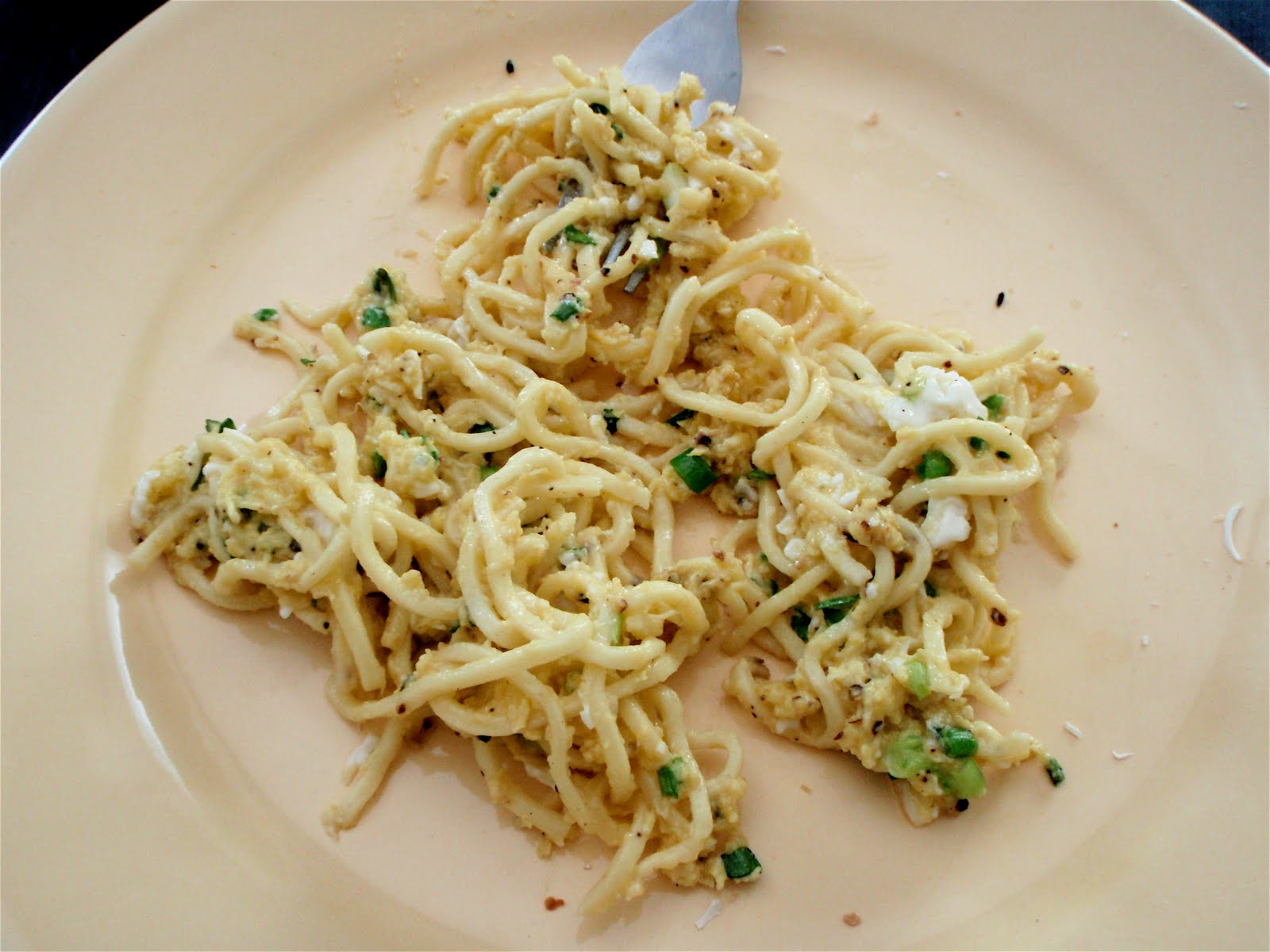
When moving, my thoughts usually turn to the thrilling prospect of exploring a new foodshed. But on my most recent move a few days ago, I found myself instead paying more attention to how my food life changed during the move itself.
Let's just say I ate a lot of things I hadn't been willing to eat up until it was time to decide between the compost bin, the garbage, and me.
Like turning one only after you've lived for an entire year, moving can't happen until after you've packed, cleaned, donated, drunk a six pack, and so forth. Since you can't snap your fingers and apparate into your new dwelling, you must experience the awkward phase of living amongst boxes and deciding up until the last moment what items are so crucial as to deserve to stay out. And your desire to get packing over with usually outweighs your desire to have access to a cutting board.
With half of your possessions in boxes and the other half at Goodwill, preparing even a simple snack becomes daunting. We did a lot of cutting directly on the top of a wooden hutch, and several meals were cooked in a single non-stick skillet with a silicon tipped rubber spatula as the only tool. For a few days we shared one plate and reused one cloth napkin.
We drank out of peanut butter jars, and then left them in the recycling bin before driving away. We ate simple meals like noodles and eggs (at top), and extravagant meals made from freezer items that simply had to go.
Since the refrigerator must be left empty, you are forced to take a good hard look at your food supply. Suddenly your Softasilk flour and vodka so cheap as to only be drinkable in jello shot form have nowhere to hide, and like children left on your doorstep, must now be dealt with.
You must throw away the jar of pitted sour cherries in brandy that you bought your girlfriend, now your wife, at the Smokehouse Deli in Cleveland back when you were a touring sketch comedian. As a general rule, if you have food left over from an entirely different career, it's time to let go.
We said goodbye to frozen pieces of our wedding cake, unmarked jars of homemade jam, and corn husks too brittle for making tamales.
On the plus side, I found myself revisiting old friends I'd nearly forgotten. Though we bid farewell to the cake, we defrosted and devoured a container of the sweet potato-peanut-pimenton soup that Amanda made for our wedding, which remains one of the best soups I've ever slurped, even after a half year in the freezer. The taste brought me back; I didn't realize that freezers were also time machines.
Perhaps the best rediscovered food was a frozen cow tongue that we cooked in the Crockpot and then ate in gorditas so good they deserve their own post. (Stay tuned.)
There were also forgotten foods that were precious enough to merit space in the U-Haul. These included jars of dehydrated chicken of the woods, local dried beans, bricks of baking chocolate and the remaining half bottle of Aquavit that Seth and Maggie brought me from somewhere in Scandinavia.
Moving also threw a wrench into gardening, which we basically can't do this season because we'll be moving again in September. But luckily, one strawberry ripened before we left.
The others will have to be a gift to our neighbors or, more likely, birds and squirrels.
When it comes to junk food, do we have free will? Not exactly.
On my recent greenwashing post, my friend and former collaborator (and former human rabbit) Jay raised an interesting question. He wrote:
"Their patrons [Pepsico] don't have to buy that stuff. Maybe organic is tough to get, but it's still not that hard to eat cheap and healthy. As you know, I'm a fat guy who really should stop eating the stuff Pepsico puts out, but I'm not going to blame them for my problems or try to shut them down."
Clearly, Jay is a model citizen. He knows the risks, he takes them, and he blames no one but himself for doing so. You can tell that he's not the kind of guy to make his fortune by suing over hot coffee burns.
But not everyone is Jay. For instance, Jay is very, very smart. He went to college: I know, I was there. And that means he acquired certain skills, such as analytic thinking, as well as funneling, that not everyone has the chance to develop.
If you're getting ready to accuse me of saying that poor people are stupid and need the government to hold their hands and tell them what to eat, relax, and then consider joining the Tea Party (notice willful omission of hyperlink). But what I am saying is that there's a fight going on for your mind -- and therefore your money -- and it's not always a fair one.
Odds are Pepsico is trying harder to influence your decisions than you are trying to resist them, and that's a battle that you're going to lose unless you're actively on the offensive. Junk food companies spend millions each year to dupe you into thinking that their products won't kill you, which they will. They create entertaining marketing campaigns, fund bogus studies and hire lobbyists. Can you still think straight despite their effort to manipulate you into thinking that their products are anything but dangerous?
Yes, but it helps if, like Jay, you have a college degree.
Could you eat healthily without going to college? Of course, but most of the statistics that I've seen generally link education with higher income, better health and living somewhere with access to fresh fruits and vegetables, i.e. in an arugula oasis rather than a food desert. In other words, much of the population is at a disadvantage when it comes to resisting Funyuns.
Perhaps the most damming evidence of this being a unfair fight is new talk about the addictiveness of junk food comparing it to hard drugs like cocaine. And let's not forget that Coca-Cola, a junk food, once contained actual cocaine.
Would we let a company market a potentially lethal product that's as hard to quit as a drug to our children? We don't let cigarette companies advertise on TV, so I'm inclined to think not. Yet turn on Saturday morning cartoons and there's Chester Cheetah, pushing his salty, brightly colored, crunchy dope.
Of course I do believe in free will, even when it comes to junk food, and if someone lifts a soda to their lips, it's their choice to do so. But do you still have free will if you're hypnotized?
You are getting very sleepy... have a Pepsi!

What better way to end a series on Hawaiian food than with fruit?
In Hawaii, fruit abounds. You'd have to work not to eat it.
Fruit nearly bursts from the corner market bins that barely contain it. It sprouts out of cracks in the sidewalk. It hypnotizes you, forcing your hand, until you come to holding a limp, empty papaya skin with seeds scattered around your bare feet like buckshot.
"What have I done?" you wonder. It was your third papaya that morning.
Our friends Jon and Layla aren't gardeners or even particularly fruit-crazed, but the apartment they rent just happens to have growing in its modest yard figs, pomelos, and avocados. I happen to have growing in my yard poison ivy.
Their next door neighbors have bananas, and nearly every other house on the street -- and everywhere else in Honolulu -- has at least one enormous papaya tree standing sentinel, its bombs of fructose ready to drop. Coconuts, pineapple and guava are similarly omnipresent.
In Hawaii, fruit just happens. While hanging out in a city park we realized that we were standing under a tamarind tree, and we picked them out of the grass and feasted (wincing). Rogue mango trees grow on vacant lots just daring you to make a dent in their incomparable bounty.
Appropriately, while in Hawaii I was reading Banana: The Fate of the Fruit That Changed the World by Dan Koeppel. In it he declares the Cavendish, essentially the only banana available to most of us, to also be the worst banana in terms of flavor. He describes other, more desirable bananas that have the texture of apples, and bananas described by the adjective "juicy."
Luckily I could go get bananas anywhere I wanted. And nearly every banana I saw was an apple banana, which are a little shorter, a little fatter, a little more tangy, and a lot better.
And so I stumbled around Hawaii high on fruit most of the time. I thought about government recommendations for fruit servings and laughed. It seemed all I needed to do was open my mouth, and fruit would fall into it, or maybe be placed there by a mongoose.

In Hawaii, Korean barbecue means something different than it does on the mainland. And that difference is price.
My good friend Layla, who we were staying with, grew up in Honolulu and then lived in New York for a number of years. The first time she had Korean barbecue outside of Hawaii was on another island: Manhattan.
She ordered what she always ordered, and when the bill came, she ordered a tranquilizer and a padded van to haul her to the nearest asylum, having gone completely insane at the difference in price. That asylum burned down to the ground, but they say you can still hear Layla's voice calling out over the ashes.... "Why!? Why was the panch'an fifteen dollars?!"
I may have exaggerated about Layla, but despite Honolulu's high cost of living, the city boasts a very low cost of Korean barbecue. The to-go container pictured at top was a massive amount of food, and though it was dominated by a huge hunk of kalbi, most of the weight was comprised of vegetable matter. These veggie sides included spicy, shredded daikon, steamed Chinese (Korean?) broccoli, bean sprouts in sesame oil, and... cuttlefish. Macaroni salad was another option. Each plate cost about eight bucks and felt like it weighed eight pounds.
The beef had that irresistible combination of sugar, soy and charcoal. Most of the sides had a twang of fermentation, and I really can't emphasize enough how much food this was. Four very hungry adults and one kind of hungry 3-year-old could barely polish off three containers. You do the math.
Apparently Korean BBQ is a popular food to pick up en route to the beach. When I was growing up in Florida, we often stopped at KFC (then Kentucky Fried Chicken) on the way to the beach.
That makes me wish that I grew up in Hawaii instead, and not just because of the beach snacks. Well actually, yes, exclusively because of the beach snacks.
The Times recently ran a story about the rise of corporate gardens. Is it a good thing to have more fresh produce in the world? Yes, especially since some of the crorps (corporate crops) are donated to food banks. Am I now going to say something about corporate gardens that isn't answered with a "yes?" Yes.
This is a blatant case of greenwashing. And if you don't know that word yet, learn it, 'cause you're going to see a lot more of it.
Is anyone really going to forgive PepsiCo for all of the diabetes, obesity, and environmental mayhem they've contributed to just because they're now growing some mint? I hope not, though I'm sure many will.
I also find it obnoxious that the people who produce junk food have the privilege of having access to organic veggies while so many of their customers don't. So I'm glad that there are a few more gardens out there, and that a few overworked execs have a chance to reconnect to life's essentials by digging in the dirt on their lunch breaks. But I almost wish they'd force everyone at PepsiCo to stick to the products that the company produces so that they'd have to share the same fate as all of their patrons.

When I first heard about butterfish, I assumed it was just a clever name. Never did I imagine that such a supple, butter-like fish actually existed. But of course it exists in Hawaii.
Or does it? Turns out that butterfish is not actually a kind of fish, though there is something called a butterfish in England, which is an eel, which is okay, because an eel is a fish. ( I know because I googled the phrase "is an eel a fish?") Here's what Hawaii Magazine had to say about all this:
"In Hawaii, butterfish is a preparation, not a species of fish. What you are looking for is actually miso-marinated black cod. (This is another confusing fish name, since black cod is actually a North Pacific sablefish, named for its dark black skin.)" 
I ate butterfish -- or whatever kind of fish it was, prepared in the butterfish style -- at the Honolulu farmer's market. The fish was just one of many wonders there, including local coffee and chocolate and of course all of the stunning tropical fruit the islands are so well known for. As you may recall from previous posts, I'm a big fan of coconut juice, and it was nice to not have to drink it out of a can for once.
Another astounding feature of the market were the plants being sold. At Massachusetts farmers markets we can buy plants like rosemary. In Hawaii, you can buy a vanilla vine.
The only downside to the market was that the produce we bought there was not allowed out of the country. The staff at the airport made us take it out of our carry-on's, even though we swore we'd eat it all by the time we reached the mainland. They wouldn't even let us eat it there in the airport.
I just hope that they bent the rules and had themselves a little forbidden fruit feast as soon as we turned and walked away.

When I couldn't remember the name of the Japanese pub we ate at in Honolulu, I knew that there was a single word I could google to have my answer. In seconds I had it: Tokkure-Tei.
That word was "norichos." And what, pray tell, is a noricho? Only the most delicious portmanteau I've ever tasted.
The noricho is a zany marriage between nachos and sushi (where the "nori" comes from). Now that I re-read that description, it kind of makes me want to vomit, but I swear that they're delicious. Who doesn't want to eat deep fried, nacho-shaped wedges of seaweed piled with roe, avocado, daikon sprouts, tomatoes, and American cheese?
Okay, so the American cheese still kind of makes me want to vomit, but after much sake it made me want to do the reverse of vomit (eat it).
The somewhat kitschy, fusion-born noricho is surely the signature dish of this very fun to eat at Japanese pub-style eatery, itself a cross between a sushi bar, a gastropub, and a tapas restaurant. But they also do straight-up sushi very, very well, as in the butter-soft, super fresh, not even remotely fishy tasting mackerel nigiri.
I happen to love mackerel in all forms, even canned, but this was the best I've ever had it. We also ate tender, charcoal grilled slices of tongue....
A sweet, creamy portabello dish that was like slow-cooked mushroom candy...
Baked Alaska rolls....
And the boiled peanuts that start the meal, which are oddly similar to the hot boiled peanuts found throughout the South.
We finished with a perfectly good grilled okra, but at that point in the meal and after that much sake, I think we were all secretly wishing we'd just ordered a second round of norichos.


 Posts
Posts


