See here for the full list or check these links for my entries in Stuff magazine's 2010 Hot 100 list:
Hot Way To Look Like a Mutant: The Vibram Five Finger
Hot Way to Ignore the Obesity Epidemic: The KFC Double Down
Hot Local Sip: Pretty Things Beer
Hot Expletive: BFD
Hot New Band: Silly Bandz
Hot Social Media Trend: Being Anti-Facebook
Hot and Headed for Mainstream: Skype
Wednesday, July 28, 2010
Hot, Hot, Hot
Monday, July 26, 2010
Summer Rolls
Is there any food more appropriate for summer than summer rolls?
Of course not.
Besides being named for the season, summer rolls are everything you want from a warm weather edible. They require little or no cooking, which makes for a cooler kitchen as well as a cooler mouthful. They easily accommodate seasonal ingredients, and more importantly, they're something most of us have only had in restaurants.
There are many reasons to cook for yourself, but the best is vanity. Sure eating at home tends to involve less fat and salt and more community, but what you really want from a home cooked meal is to replicate something that you previously thought only came from a menu, and to gloat about it.
Lording over a plate of pudgy, translucent summer rolls as thick and nutritious as enormous grubs while in the comfort of my own kitchen makes me feel like a king. Knowing that my version costs a fraction of what I would pay at a restaurant makes me feel like a king who is also very rich.
We started making s.r.'s with raw tofu, basil, mung noodles, bok choi and peanut sauce on the side, but the current and preferred evolution involves the same noodles plus fried tofu, cilantro, cucumber and a vat of chili paste in which to schmear these pliant little wraps.
I'd write up a recipe if there were anything to it besides this: buy rice paper wrappers. Moisten them and fill with whatevs.
Thursday, July 22, 2010
Quote of the Day
Wednesday, July 21, 2010
Tuesday, July 20, 2010
Sumac Agua Fresca
If your soul screams for yet another post about a sour tea made from wild ingredients, read on. If you'd rather read about designer cupcakes, might I suggest another food blog.
To begin, let's play a little game of word association. I'm going to say a word, and I want you to think of the first word that immediately jumps into your mind. Ready?
Me: sumac.
You: POISON!
But have no fear. The only similarities between poison sumac and regular -- or "delicious" -- sumac are literary. Though they share a name, they look nothing alike.
And yet a hairy, red, seed-studded head of common sumac just doesn't look like something you'd want to eat. And it isn't. But it is something that you want to drink. Simply muddle a ripe head in cool water, let stand for about ten minutes, strain, and drink. The resulting liquid should be a shade of salmon that can only be described as "lovely." It is to pink lemonade as manna is to food.
Besides za'atar, this simple drink is my only experience ingesting sumac, though I could easily imagine a sumac syrup splashed into champagne, among other possibilities.
Though I have little desire to experiment given the quality of sumac tea and the ease with which it is made. Sumac tea is tart and fruity, part citrus, part berry. It is a dead ringer for a splash of pure cranberry juice in water, which is something I drink all summer but will never need to pay for again. Sumac-ade, as it is often called, is just as good if not better, not to mention carbon-neutral and obtainable without the exchange of currency. Nor does it come in a wasteful container; I carried mine home in a hat.
Brewing a cool, refreshing glass of tangy sumac jus doesn't even require a heating element, and the process could therefore predate the invention of fire. Forget about so-called organic food flown in from China: this stuff is the essence of sustainability.
----------------------------------
Sumac Agua Fresca (aka Rhus Juice)
serves 6
Ingredients:
1 quart of water
1 ripe sumac berry cluster (dark red, picked in mid-summer to fall)
To test a berry cluster for flavor, gently rub it and then lick your fingers. They'll taste tangy if you've got a winner.
Twist or snip off the berry head. Thoroughly muddle it in the water using a wooden spoon or your fingers. Pour through a fine strainer or cheesecloth removing all seeds and hairs, which can irritate the throat.
Sweeten if desired. Serve room temperature or cold. Connect with nature.
Tuesday, July 13, 2010
The Neo-Oeno's
See here for my article in Stuff Magazine Boston about local neo-oenophiles, or "neo-oeno's:"
http://stuffboston.com/stuffboston/archive/2010/07/12/wine-declassified-today-s-oenophiles-are-embracing-wine-s-unstuffy-side.aspx
Friday, July 9, 2010
Backyard Iced Tea
The Times' article about the Danish chef who incorporates wild edibles into haute cuisine made me feel three things: hungry, ecstatic, and irritated.
Hungry because I want to eat "pulp of air-dried sea buckthorn with pickled rose hips." Ecstatic that an international star chef is making his name by cooking with undomesticated flora. Irritated for the same reason.
As much as I loved the article, I wish we lived in a world in which it wasn't news. I wish that using the free and compelling ultra-local bounty of the natural world was the default, not a bold move that attracts the attention of the press.
I've said it before and I'll say it again: eating wild edibles is a sublime experience. A bite of your environment will shower you with oodles more terroir than wine from thousands of miles away. It will surprise and delight your palate infinitely more than, say, a potato. And perhaps most importantly, it will give you a glimpse of the interconnectedness with the natural world that used to fuel our existence as a species. Which, if you're spending your free time reading a blog, chances are you could use.
The food world is so gaga for novelty, and yet new and exciting tastes abound right under our feet. Everyone (including me) made such a big stink when black garlic hit the scene, but what about the weeds in your lawn? There you're almost guaranteed to find clover, plantain, poor man's pepper, dandelion greens (and flowers and roots and buds) and chickweed, all delicious, all compelling, all free. You'll also find the source of one of my favorite wild teas: oxalis.
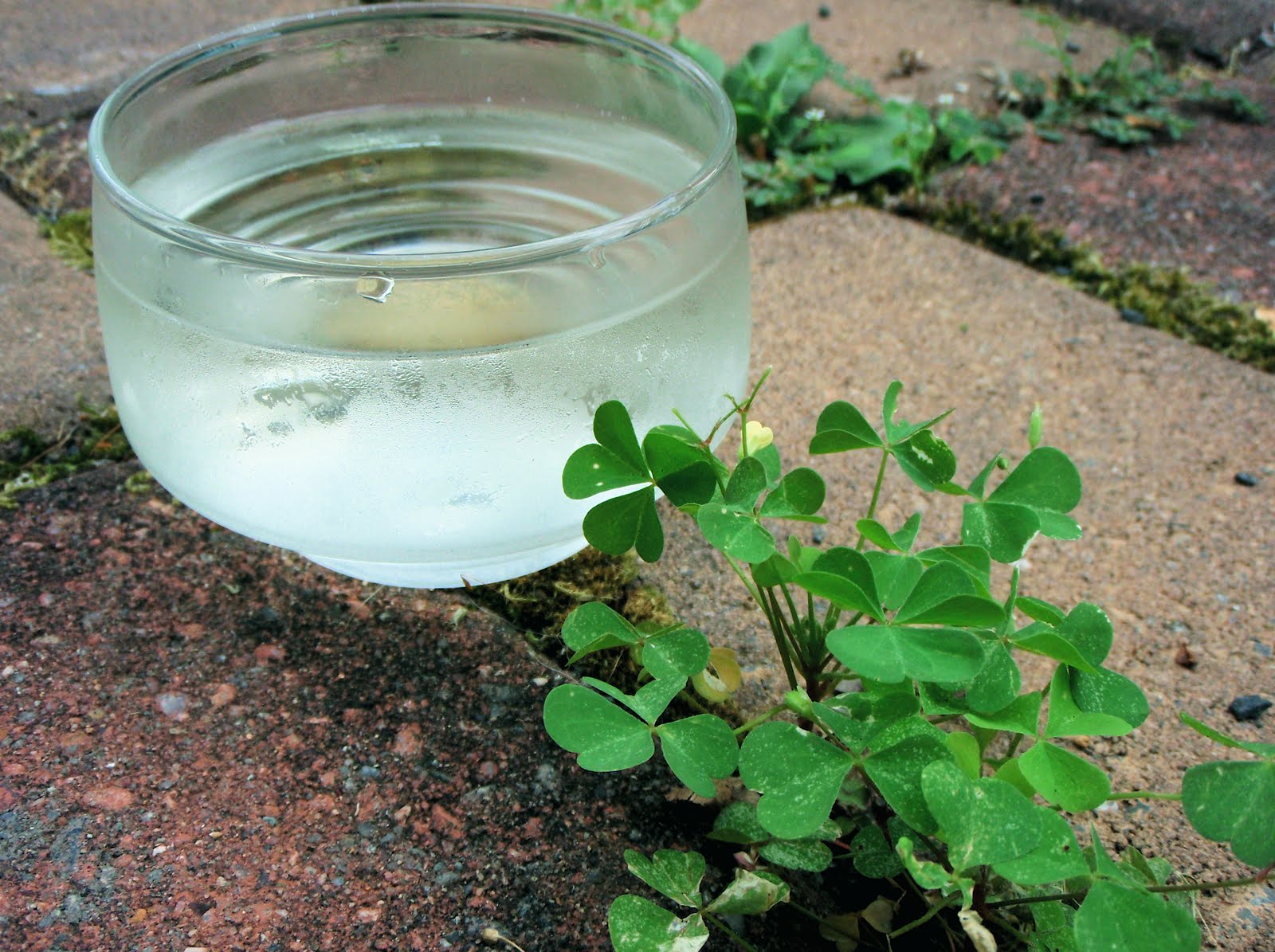
This morning I started the day with an ice cold glass of oxalis tea. Oh, you've never had it? Funny, it grows everywhere, it's as easy to make as microwave popcorn, and it tastes totally crazy.
Oxalis tea is a refreshing summer drink with a surprisingly citrusy twang and just a hint of vegetable funk. Pick oxalis from anywhere that you trust. Oh, you don't trust your own lawn because you spray it with toxic chemicals? Hmm, maybe you should think about that. Boil water. Steep a handful of fresh leaves and stems in the hot water for about five minutes. Strain. Cool. Drink. Call the New York Times.
Monday, July 5, 2010
Navajo Tea
While visiting friends on the Navajo Nation a few years back, Elise and I were given a gift of some Navajo tea. When we got home, I stashed it in the back of my tea cupboard where it would stay preserved in the cool and dark. Which also meant that I would forget about it for a couple of years.
Though this video shows one bundle making one cup of tea, we were told that it would yield about fifteen cups, and so we had to wait an additional few months after rediscovering the tea for a time when we had enough guests to drink it. That turned out to be Elise's birthday. Though techniques vary, we tried pouring a pot of boiling water over the single bundle in a large, ceramic mixing bowl and letting it steep for about ten minutes.
The tea was wonderful. I know it might seem fairly obvious to describe a tea that is essentially dried grass as "grassy," but it was. There was a faintly sweet flavor and an aroma like pungent hay. The liquor was thicker than with most true teas, the color a rich gold.
It is difficult to discuss this tea without hyper-romanticizing the West. So permit me the following: the tea was an expression of the land it had grown out of, and in it you could taste the bare rock, sand and sun-baked wood and herbs that struggle to lay claim to a spartan landscape. Talk about terroir.
To me, this tea is about as sacred as food can be. It was a gift, it is a traditional and culturally relevant food, it has medicinal qualities, and, being a wild crop, the tea was foraged and not cultivated, which means this species has been relatively uninfluenced by our presence on the planet. Compare that to something you might find at the supermarket. Orange juice with fish in it, for instance.
The funny thing is that when we were given the tea we were drinking instant Folger's from a big, red plastic tub. I don't want to give the illusion that most Navajo are out foraging for their food. Like any rural, low-income community, most of their food is store bought and highly processed. But when the conversation turned to traditional crops, our friend went into his pantry and brought out a Ziploc bag bearing three hand-tied bundles of the wild tea.
It was inspiring to see such a traditional food still earning a place on the shelf next to products that are engineered to be addictive and are marketed with millions of dollars. But the best part is that I still have two more bundles.
Wednesday, June 30, 2010
Summer Cooking Circa 1775
See here for my article in today's Globe on Revolutionary War reenactment cooks:
http://www.boston.com/lifestyle/food/articles/2010/06/30/revolutionary_war_reenactor_loyal_to_the_king_and_authentic_ingredients/
Thursday, June 24, 2010
On Eating Lions
The following is an e-mail exchange between myself and my good friend Andrew Slack of the HP Alliance. The subject is eating lions.
Andrew:
I've said it before and I'll say it again: eating lions is wrong:
http://www.telegraph.co.uk/sport/football/world-cup-2010/7848758/World-Cup-2010-US-restaurant-to-serve-World-Cup-lion-burgers.html
Soooo f*cking horrible.
Me:
If you're not opposed to eating animals in general, why is this so bad? If they're raised (and presumably slaughtered) humanely and are bred in captivity and not removed from the ecosystem that depends on them, why is eating a lion worse than eating a cow? Is it a matter of intelligence of the animal? If so, it may be that pigs are smarter than lions, but it doesn't make news when we eat them.
Andrew:
Look man, you can come at me with all of your "intellect" and burst my self-righteous bubble with "facts" and even expose my childlike hypocrisy and simplistic sense of reasoning with your "brain power" but if I've said it once, I've said it a million times: "I'm totally right in my opinions even if they sound irrational - even if I don't know what I'm saying - I know what I'm saying."
So yeah - I'm definitely overreacting to this story and I'm sure if you say so, pigs are smarter than lions. So let's then just say that when it comes to eating meat, I'm sort of a simple minded rank-in-file American. And now let's take a step back and look at me as a specimen to better understand what the issue driving the "average American meat eater" (me in this case) is with eating lions. And perhaps something valuable about either the human psyche's past, present, or future can be gained by looking at my habits and knee jerk, frozen-in-childhood reaction:
Me:
Can I post that on Tea and Food?
Andrew:
Sure!
Monday, June 21, 2010
The Coolest Breakfast
When it's already too hot in the morning, the rest of the day stretches before you like a vast, uncrossable desert. Somehow I know I'll make it to the point when I can lie in bed naked with a fan pointed at me, but I just don't know how I'm going to get from here to there.
Once I have that realization, I can't bring myself to do any activity that would result in even the slightest increase in temperature. Turning on a burner to boil water for tea or oats is out. I'd just as soon turn on the toaster as stick my head in a vat of molten glass Even the warmth generated by the underside of laptop seems too much.
In such weather I often go rabbit. I eat raw fruit and vegetables, often unadorned. (And for some reason I find myself dodging the shadows of hawks). Meat loses much of its appeal.
Additionally, I seek out those foods that promise some cooling effect, by which I mean foods that have an uplifting flavor, such as a lemon, a cold temperature, such as anything out of the refrigerator, or foods whose essences are considered cooling in nature in traditions such as Ayurveda and Chinese medicine. Like corn silk tea.
And this morning, I think I created the ultimate cool food: yogurt, melon, and mint.
Though I don't usually eat dairy, I do make an exception for yogurt during the summer. Why? Because at some point I convinced myself that it was a good idea. The yogurt I used today is, I think, the most flavorful plain yogurt I've ever had: Sidehill Farm, a raw milk yogurt that seems to be a local favorite around my summer residence in the Northampton area (by which I mean I'm living close to Northampton but somewhere cheaper). The melon was a Santa Claus melon. The mint was, I think, spearmint, from the garden.
After a few bites (slurps?) it suddenly felt ten degrees colder. The stuff is as cooling as toothpaste, and just as minty-fresh. It gave me the courage to face the warmth of the laptop.
Friday, June 18, 2010
Gastronationalism
See here for food historian Rachel Laudan's post on French laws regarding foie gras.
The laws protect f.g. as part of the "gastronomical heritage of France," yet the way the stuff is created (and where it is consumed, which is to say here in the U.S. and everywhere else people have more money than they know what to do with) bears little semblance to "heritage."
Unless of course French farmers of antiquity had machines that could force feed a duck (not a goose) in a matter of seconds?
I know Americans are quick to forget our food history in the face of propaganda from the industry and government and often a combination of the two, but France? Isn't this the country where a mustachioed sheep farmer drove a tractor into a McDonalds while smoking a pipe?
Wednesday, June 16, 2010
Food Writers Who Like Food
The other night I was invited for dinner at my good friend Sophie's apartment. And a funny thing happened that relates to my career as a freelance writer focusing on food journalism. Because I write about food, Sophie was concerned that I wouldn't like the food.
When people find out that I'm a food writer, they often become self conscious about what they serve me or even what they eat in my presence. I understand the connection, but I'd like to make something clear: food writers like food. In fact, they like food more than normal people.
Unless you're inviting a restaurant critic to have dinner in your restaurant and the also critic happens to have an assignment to review your restaurant, you really have nothing to worry about. Think of a food writer as a baleen whale and food as plankton. We swim around with mouths agape, taking in as much sustenance as possible. To make the comparison even more apt, it occurs to me that I'd happily eat a plate of plankton, which is what we might soon be reduced to anyway.
Sophie and Kailie, another friend also in attendance, made an asparagus, mushroom, goat cheese frittata, which they served with a salad made with greens from Sophie's lush, adjacent urban garden. For dessert, there was a fruit crisp with rhubarb, apples (or were they pears?) and berries. Wine flowed.
Of all people, S. and K. would be the last I'd expect to hesitate when breaking bread with me. The three of us used to work together teaching Shakespeare at a camp in Vermont (the two of them still do) with a bare bones budget, and for lunch we'd frequently find ourselves squatting in a field, eating tuna out of the can and dipping carrots in whatever edible paste-like substances we could find.
That said, they were right to be concerned. The frittata had a little too much goat cheese.
Tuesday, June 15, 2010
Quote of the Day
From this article in the NYT:
"Most of the cavemen at Mr. Durant’s gatherings are lean and well-muscled, and have glowing skin. A few wear trim beards. Some claim that they no longer get sick. Several identify themselves as libertarians."
Monday, June 14, 2010
Those Tongue Gorditas
These are the aforementioned tongue gorditas I ate while moving. They were so good that they themselves were quite moving.
Friday, June 11, 2010
The Oil Spill and Gulf Coast Food Security
Perhaps my all around favorite person in the world of food is author, activist and conservationist Gary Paul Nabhan, founder of the project known as RAFT (Renewing America's Food Traditions). See here for his piece in yesterday's Grist about how the BP spill is affecting precious food sources along the Gulf Coast (and the rest of us who love them).
The gist of it is that now more than ever we need to support those fishermen (and gator hunters) in jeopardy. There's also this to consider:
"Unfortunately, this crisis is not just an environmental one, but a food justice one. The spill is economically devastating to some of the most marginalized ethnic communities in the United States, including Cajun, Houma Indian, "Creole" Black, Vietnamese, Cambodian, and Latino communities in and near the Mississippi delta. And while most U.S. agencies and media have sidestepped this issue, Cuban and Mexican fishermen are just likely as Gulf Coast residents to be have their livelihoods disrupted by the oil spill."
Thursday, June 10, 2010
Stone Soup Dinner, Part 1
This year I'm on the planning committee for the Stone Soup Dinner, an event that showcases the agriculture bounty of Concord, MA. We kicked off the planning sessions with what else but a pig roast.
I'd had pig roasted in a Caja China (now with bottle opener!) once before, and it was terrible. Not tender, it was kind of like chewing bubble gum that tasted like pork. Which isn't something I'd be adverse too, but eventually I do like to swallow my food. This pig, however, was divine, with tender flesh and super-crackly skin.
As good as the pig roast was, the full scale dinner promises to be even better. If you live in Boston or anywhere else in the Metro-West area, clear your calendar for September 26th. See here for a list of Concord businesses at which you can purchase tickets.
Wednesday, June 9, 2010
Quote of the Day
From this Mother Nature Network article:
"Kangaroo is a red meat very similar in appearance to tenderloin that might come from ox."
Oh, ox tenderloin? Yes, I'm sure we're all well acquainted with it.
Perhaps the Most Interesting Ingredient on Earth
From the New York Times food section:
"But as miraculous as its biblical apparition may seem, manna is real and some chefs have been cooking with it."
See the full article here.
Tuesday, June 8, 2010
Fiddleheads and Tortellini, Together At Last
This dish was born from the happy marriage of long-frozen tortellini and pretty far-gone fiddleheads from the discount rack at my local chain grocery store. Though both had been cast out from society and nearly left for dead, these two orphans found that they were made for each other. And then I ate them.
Since I think of fiddleheads as a wild crop (anyone know if they can be cultivated?), I was deeply saddened to see them imprisoned in plastic wrap and being sold for a dollar a package in that sad clearance section in the produce section. Sharing space with bruised and mealy red "delicious" apples from Argentina were these iconic New England heralds of spring. I knew it was my job to rescue them.
They took a little more debearding then usual, but once sorted cleaned, blanched, and shocked, they looked as good as new. The tortellini was a little gummy from its lengthy cryogenic sleep, but being from the excellent pasta makers at Capone, I couldn't bear to let it go.
I tossed the al dente tortellini with the blanched 'heads in olive oil and a little more balsamic vinegar than you'd think, cracked in plenty of pepper and dusted it with parmesan. It was good. The fresh, crispy, gooey fern sprouts paired well with the firm, chewy, salty pasta. I'm surprised I haven't seen the combo before.
What I liked even more than the excellent flavor was the way the fiddleheads wrapped their tentacles around the pasta, as if to say "we're going down together." It was like eating Romeo and Juliet, which is appropriate since tortellini are said to have been inspired by the belly button of an Italian woman.