
See here for my post on The Jew and the Carrot about pepitada, a drink made from steeped, ground melon seeds. Having tried it, I'll never compost the seeds again.

See here for my post on The Jew and the Carrot about pepitada, a drink made from steeped, ground melon seeds. Having tried it, I'll never compost the seeds again.

As a wedding present to some friends, Elise and I constructed a seven course meal this past Saturday. The courses were:
1. Cheese (aged Gouda, cheddar, Parmigiano, a super-cowy local feta) and Castelvetrano olives.
2. Peter's Point oysters
3. Purple oak leaf and arugula salad with toasted almonds and avocado.
4. Mushroom puree.
5. Wax beans in butter, sherry and sage.
6. The Best Thing I've Ever Made.
7. Caribbean Red Papaya and Greek (white) yogurt.
Only the next day did we realize how little cooking we actually did, having focused on minimal presentation of high quality, mostly local ingredients. This goes along with my culinary theory of get good stuff, don't f*ck it up. For instance, for an amuse we served three still-wrapped ground cherries. They were as complexly flavorful and engaging as anything made by a human.
The mushroom soup was a clash of wilderness and civilization. I made a stock from last year's tougher bits of Chicken of the Woods, which we then pureed with the most banal of fungi, the white button mushroom, partly to prove that even a pathetic mushroom is still an incredible thing. The marriage of the wild and civil 'shrooms was a happy one, as is our friends'.
The papaya and yogurt came from a discovery we made last week in NYC. Hungry and stuck in a not very fun or affordable part of town in terms of eating, we stopped at a corner store and bought Greek yogurt and a half of a ripe papaya. We dumped the entire container of yogurt into the cavity of the papaya and slobbered over it on a city bench.
The thick, dry yogurt made for a fascinating texture contrast with the juicy, squishy papaya. The only change we made in serving it to friends was a little drizzle of honey. Another thing I like about serving this for dessert is that it it doesn't contain sugar and isn't cake.
And now for #6, The Best Thing I've Ever Made. In the Crockpot I braised two grass fed beef shanks in an improvised Sichuan liquid of soy sauce, honey, star anise, one clove, some smashed ginger, three kinds of "pepper" (whole black , dried red, toasted Sichuan peppercorns) a splash of rice cooking wine and one of cider. This simmered for about six hours, and you can imagine how it made the apartment smell.
The soft, sweet-salty, aromatic meat was pulled from the bone and served atop a single, perfectly brown, crusty, pudgy latke cooked by Elise. On top of the meat were matchsticks of tart green apple tossed with chopped, fresh red chiles, lemon juice, salt, and finely minced cilantro stems.
I'd been wanting to make it ever since having something similar at Market. The main difference, besides the latke, was that the heat in Jean-Georges' apple slaw was invisible. I'm not entirely sure how it got there (rubbing? injection?), which drew me in all the more. But, like a savage, I used actual bits of peppers in mine.
I have not yet mentioned the one thing unanimously declared the night's best. After the entree I let everyone have a spoonful of the beef's cooking liquid, a sublime nectar composed of the ingredients I've already discussed plus the now rendered marrow from the shanks. I could describe it, but I'd rather use my short time on this earth to think about it one more time.
It was a good meal and, we presume, a good gift. At least as good as a nice serving platter.
If you'd like to try Navajo tea, and in case you missed this in the comments, Darren has stepped forward as a source for the Southwest Navajo tea that grows wild in grazing land near his home. To buy a bundle, you can email him at ddamon871@gmail.com.
From the always lucid Rachel Laudan:
"If we urge the Mexican to stay at her metate, the farmer to stay at his olive press, the housewife to stay at her stove, all so that we may eat handmade tortillas, traditionally pressed olive oil, and home-cooked meals, we are assuming the mantle of the aristocrats of old."
See the full piece here.

Seth and Maggie are good at bringing me edible presents from distant lands. Very good.
From their honeymoon in Scandinavia I received dried fish and aquavit. From their tea researching jaunt through India and Pakistan I obtained fermented cauliflower leaves, yeast for making the rice beer known as chang (aka "thoo-n"), coriander honey, dried cubes of yak cheese, saffron, cardamom, and of course tea.
Most of the tea they brought me, like most of the tea in India, was black. Since I haven't found an Indian black tea that I've loved, I found myself pouring most of my gift for guests; guests, as a people, generally want black tea and don't care where it's from. And so I guilty found myself ignoring my last sack of tea. It said "Darjeeling" and the bag was black, so I assumed its contents were as well.
Oops! As luck would have it, my mistake was pointed out by Dave, the one guest who doesn't
want black tea. Turned out I had a white tea, and it was not only Organic Makaibari Silver Tips but Organic Makaibari Silver Tips Imperial. The Imperial is apparently only picked when conditions are right and under "full moon beams."
I haven't toyed with temperature and brewing time enough to fully report on OMSTI, but so far it's been fun. A short brew made with not very hot water (my system: I use the extra water Elise boils for coffee once enough time has passed for me to think "maybe I'll have some tea," at which point it's somewhere between the temperature for oolong and for ice) that I'm drinking right now is predominantly tannic, also grassy, and not quite roasty but... let's call it toasty. Why I have no idea, since white tea is not roasted. This batch must have grown next to a shrub that was struck by lightning.
A longer brew of leaves on their third or fourth steep produced a viscous cup with notes of citrus peel and a sort of off-fruitiness that I can't quite place. Call it resin. Again, I need more time to figure this one out but will keep you posted.
Seth and Maggie: sorry it took so long. But look at it this way -- now you gave me an aged white tea!

Chole's homemade Mexican food is not the only reason I like the Craftsbury, VT farmers market. I also like it for every other reason.
The market's produce is as picturesque as its backdrop: there are the Green Mountains, and then there are the mountains of greens.
Though it looks quaint, the Craftsbury market is a radical departure from the industrial food system that appears as though it keeps trying to poison us with salmonella. Maybe it's the fact that the market is a stone's throw from Sterling College, which teaches sustainable farming almost as a way of life, or the fact that's it's just Vermont.
This year I was surprised to find one farm selling gorgeous oyster mushrooms that they cultivate on inoculated logs. I bought a half pound (for half the price that I expected) and that night Peter cooked them up with a splash of sherry and some raw milk redolent of alfalfa.
It was a cold night for the summer, reaching down into the 40's, which made sleeping on the hammocks outside a little challenging for the same reason that bridges ice before roads. But that meant we had the wood stove going, and when you've got a wood stove going, why turn on the gas stove? Peter simmered the mushrooms atop it.
Locally grown oyster mushrooms simmered in local, raw milk, a wood stove, a communal meal, human interaction, no salmonella, community: this is precisely what Stephen Budiansky pretends to forget about the local foods movement.

My recent oral surgery has imposed a challenging dietary constraint: a week of nothing but liquid. And to tell the truth, it hasn't been that bad.
Maybe it's just the painkillers speaking, but boy do my hands feel heavy.
What I meant to say was that the liquid diet actually has its perks. What Pollan famously called the omnivore's dilemma (figuring out what to eat in a post-modern food culture) becomes a little easier without the use of teeth. Suddenly the question is not whether fair trade is more important than organic, but will it fit in a blender? If the answer is yes, I've probably eaten it -- or rather delicately swallowed it -- in this past week.
My meals can generally be divided into smoothies and soups, meaning they tend towards sweet or savory with a base of either soy milk or chicken stock. I made a big batch of the latter using a summer's worth of frozen bones, the last, shriveled onions from our winter CSA, a couple of carrots, herbs from the garden, and a glug of sherry. It's been my best friend this week, excusing almost everything as soup.
The challenge of course is to make mug after mug not only bearable but also appetizing. The pureed can of seafood chowder and spinach pictured at top was no such success.
My favorite creations have allowed me to enjoy liquid foods just as much as their solid counterparts. There's something molecular-gastronomic about drinking a peach, and it does cause you to reconsider and appreciate the subject in a new light.
The pureed peaches I've been slurping have been one of my favorite "foods": two extremely ripe local peaches, a thumb of super-ripe banana for added sweetness, and just enough soy milk to enable a vortex in the blender. When you remove the lid of the blender, a concentrated wave of peach aroma clobbers your nostrils. You swoon, though again, this may be the painkillers.
Another success has been liquified beans and rice. Sounds awful doesn't it? And yet the concoction is flavorful, comforting, and somewhat mysterious. If someone put a bowl of it in front of you at a restaurant, you'd find it palatable, familiar and yet impossible to place. I make mine by browning onion and garlic, using stock as the liquid and adding about a teaspoon of cumin per serving. The rice yields a particularly velvety texture.
Heck, I'm sticking to liquids from here on out. I know that's a heavy handed statement, but remember that my hands really do feel heavy. Smoothie time!

Food is one of the many reasons I spend two weeks each summer teaching Shakespeare in the Northeast Kingdom of Vermont (see here for this weekend's show listings).
The photo at top captures a runny poached egg yolk on the precipice, just one component of a meal our staff interns whipped up that they referred to as "mega-brunch." Also on the menu were homemade popovers, eggs from friends(' chickens), hollandaise, and, at least in my case, three mimosas. These made climbing Mt. Pisgah a little difficult later in the day.
I've said it before and I'll say it again: I've said it before and I'll say it again: there is always spirited eating to be had in VT, thanks to the ingredients, the company, or both.
Heck, the compost pile that I overlook as I type has better produce in it than most supermarkets. 

.... make herb blossom water. Sounds delicious, doesn't it? No. It sounds like nothing. But an infusion of basil and mint blossoms is ethereal, cooling, and a good way to use up part of the plant that you're supposed to remove anyway.
They say that pinching the blossoms from herbs makes the plant redirect it's energy into producing more of what you want: fat, juicy, aromatic leaves. I've never tested an unpinched herb plant against a pinched one, so I can't speak from experience about the effect on your harvest, but going out and removing the blossoms every few days gives you a fun little job that makes you feel like what you do in the grand scheme of things is important: I pinch the flowers off of the basil plants, therefore I am.
But what to do with those decapitated blossoms? Keep basil flowers in your pocket and they'll make your keys smell nice, but they'll turn black. Keep them in a pitcher (or glass) of cold water and their oils will wend their way about the water molecules, imparting a fresh and slightly sweet taste to the drink.
Another interesting test would be this cold brew versus a hot steep. My guess is that, as in cold-brewed coffee, this eliminates any trace of bitterness. Unless you're a pollinator.
See here for the full list or check these links for my entries in Stuff magazine's 2010 Hot 100 list:
Hot Way To Look Like a Mutant: The Vibram Five Finger
Hot Way to Ignore the Obesity Epidemic: The KFC Double Down
Hot Local Sip: Pretty Things Beer
Hot Expletive: BFD
Hot New Band: Silly Bandz
Hot Social Media Trend: Being Anti-Facebook
Hot and Headed for Mainstream: Skype

Is there any food more appropriate for summer than summer rolls?
Of course not.
Besides being named for the season, summer rolls are everything you want from a warm weather edible. They require little or no cooking, which makes for a cooler kitchen as well as a cooler mouthful. They easily accommodate seasonal ingredients, and more importantly, they're something most of us have only had in restaurants.
There are many reasons to cook for yourself, but the best is vanity. Sure eating at home tends to involve less fat and salt and more community, but what you really want from a home cooked meal is to replicate something that you previously thought only came from a menu, and to gloat about it.
Lording over a plate of pudgy, translucent summer rolls as thick and nutritious as enormous grubs while in the comfort of my own kitchen makes me feel like a king. Knowing that my version costs a fraction of what I would pay at a restaurant makes me feel like a king who is also very rich.
We started making s.r.'s with raw tofu, basil, mung noodles, bok choi and peanut sauce on the side, but the current and preferred evolution involves the same noodles plus fried tofu, cilantro, cucumber and a vat of chili paste in which to schmear these pliant little wraps.
I'd write up a recipe if there were anything to it besides this: buy rice paper wrappers. Moisten them and fill with whatevs.
From The New York Times Cookbook by Craig Claiborne (1961):
"Swizzle sticks should never be served with champagne except to an invalid whose stomach cannot support the sparkle. Swizzle sticks destroy in a second what required a miracle of years to produce."

If your soul screams for yet another post about a sour tea made from wild ingredients, read on. If you'd rather read about designer cupcakes, might I suggest another food blog.
To begin, let's play a little game of word association. I'm going to say a word, and I want you to think of the first word that immediately jumps into your mind. Ready?
Me: sumac.
You: POISON!
But have no fear. The only similarities between poison sumac and regular -- or "delicious" -- sumac are literary. Though they share a name, they look nothing alike.
And yet a hairy, red, seed-studded head of common sumac just doesn't look like something you'd want to eat. And it isn't. But it is something that you want to drink. Simply muddle a ripe head in cool water, let stand for about ten minutes, strain, and drink. The resulting liquid should be a shade of salmon that can only be described as "lovely." It is to pink lemonade as manna is to food.
Besides za'atar, this simple drink is my only experience ingesting sumac, though I could easily imagine a sumac syrup splashed into champagne, among other possibilities.
Though I have little desire to experiment given the quality of sumac tea and the ease with which it is made. Sumac tea is tart and fruity, part citrus, part berry. It is a dead ringer for a splash of pure cranberry juice in water, which is something I drink all summer but will never need to pay for again. Sumac-ade, as it is often called, is just as good if not better, not to mention carbon-neutral and obtainable without the exchange of currency. Nor does it come in a wasteful container; I carried mine home in a hat.
Brewing a cool, refreshing glass of tangy sumac jus doesn't even require a heating element, and the process could therefore predate the invention of fire. Forget about so-called organic food flown in from China: this stuff is the essence of sustainability.
----------------------------------
Sumac Agua Fresca (aka Rhus Juice)
serves 6
Ingredients:
1 quart of water
1 ripe sumac berry cluster (dark red, picked in mid-summer to fall)
To test a berry cluster for flavor, gently rub it and then lick your fingers. They'll taste tangy if you've got a winner.
Twist or snip off the berry head. Thoroughly muddle it in the water using a wooden spoon or your fingers. Pour through a fine strainer or cheesecloth removing all seeds and hairs, which can irritate the throat.
Sweeten if desired. Serve room temperature or cold. Connect with nature.
See here for my article in Stuff Magazine Boston about local neo-oenophiles, or "neo-oeno's:"
http://stuffboston.com/stuffboston/archive/2010/07/12/wine-declassified-today-s-oenophiles-are-embracing-wine-s-unstuffy-side.aspx
The Times' article about the Danish chef who incorporates wild edibles into haute cuisine made me feel three things: hungry, ecstatic, and irritated.
Hungry because I want to eat "pulp of air-dried sea buckthorn with pickled rose hips." Ecstatic that an international star chef is making his name by cooking with undomesticated flora. Irritated for the same reason.
As much as I loved the article, I wish we lived in a world in which it wasn't news. I wish that using the free and compelling ultra-local bounty of the natural world was the default, not a bold move that attracts the attention of the press.
I've said it before and I'll say it again: eating wild edibles is a sublime experience. A bite of your environment will shower you with oodles more terroir than wine from thousands of miles away. It will surprise and delight your palate infinitely more than, say, a potato. And perhaps most importantly, it will give you a glimpse of the interconnectedness with the natural world that used to fuel our existence as a species. Which, if you're spending your free time reading a blog, chances are you could use.
The food world is so gaga for novelty, and yet new and exciting tastes abound right under our feet. Everyone (including me) made such a big stink when black garlic hit the scene, but what about the weeds in your lawn? There you're almost guaranteed to find clover, plantain, poor man's pepper, dandelion greens (and flowers and roots and buds) and chickweed, all delicious, all compelling, all free. You'll also find the source of one of my favorite wild teas: oxalis.
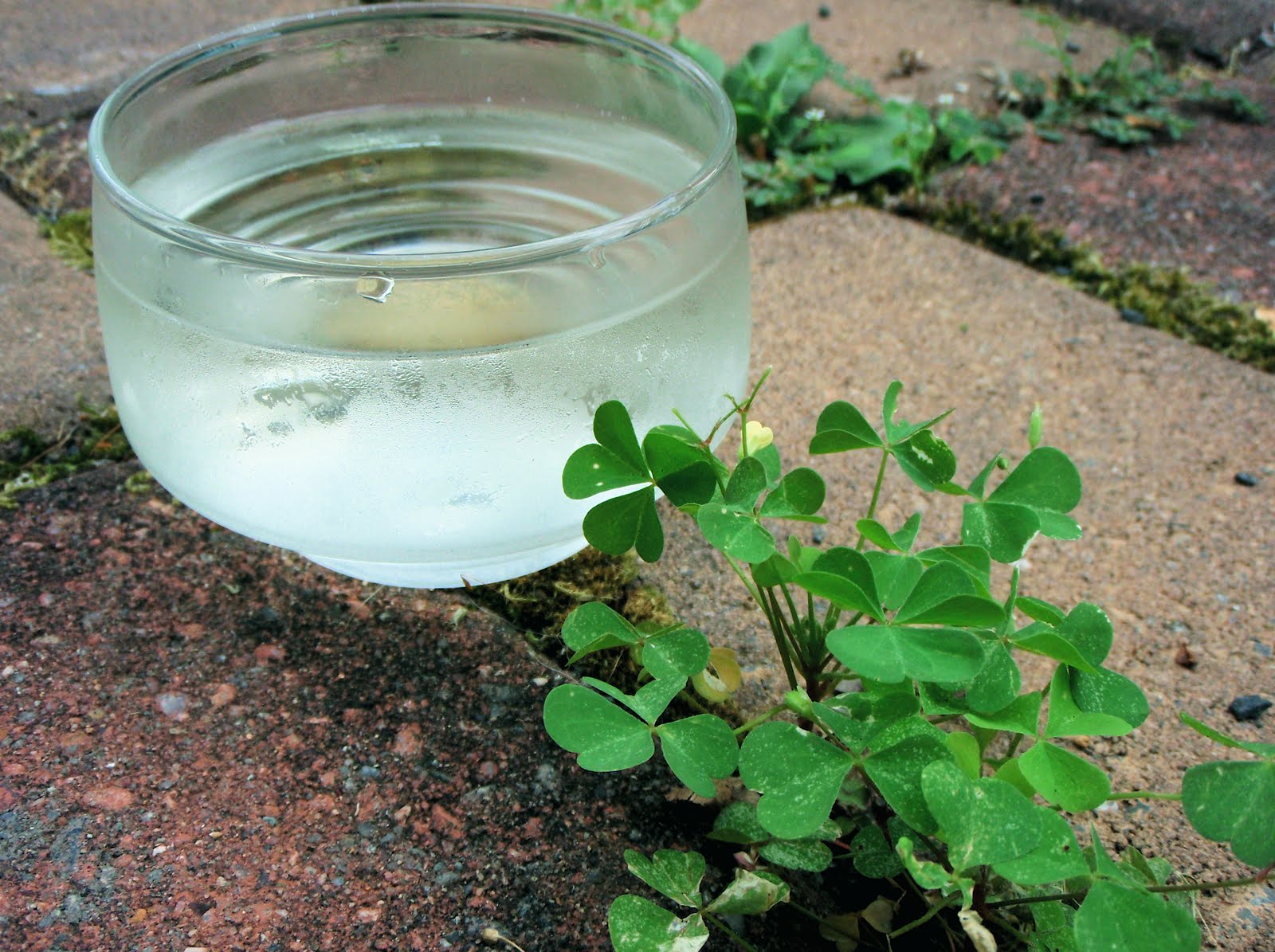
This morning I started the day with an ice cold glass of oxalis tea. Oh, you've never had it? Funny, it grows everywhere, it's as easy to make as microwave popcorn, and it tastes totally crazy.
Oxalis tea is a refreshing summer drink with a surprisingly citrusy twang and just a hint of vegetable funk. Pick oxalis from anywhere that you trust. Oh, you don't trust your own lawn because you spray it with toxic chemicals? Hmm, maybe you should think about that. Boil water. Steep a handful of fresh leaves and stems in the hot water for about five minutes. Strain. Cool. Drink. Call the New York Times.
 While visiting friends on the Navajo Nation a few years back, Elise and I were given a gift of some Navajo tea. When we got home, I stashed it in the back of my tea cupboard where it would stay preserved in the cool and dark. Which also meant that I would forget about it for a couple of years.
Though this video shows one bundle making one cup of tea, we were told that it would yield about fifteen cups, and so we had to wait an additional few months after rediscovering the tea for a time when we had enough guests to drink it. That turned out to be Elise's birthday. Though techniques vary, we tried pouring a pot of boiling water over the single bundle in a large, ceramic mixing bowl and letting it steep for about ten minutes.
The tea was wonderful. I know it might seem fairly obvious to describe a tea that is essentially dried grass as "grassy," but it was. There was a faintly sweet flavor and an aroma like pungent hay. The liquor was thicker than with most true teas, the color a rich gold.
It is difficult to discuss this tea without hyper-romanticizing the West. So permit me the following: the tea was an expression of the land it had grown out of, and in it you could taste the bare rock, sand and sun-baked wood and herbs that struggle to lay claim to a spartan landscape. Talk about terroir.
To me, this tea is about as sacred as food can be. It was a gift, it is a traditional and culturally relevant food, it has medicinal qualities, and, being a wild crop, the tea was foraged and not cultivated, which means this species has been relatively uninfluenced by our presence on the planet. Compare that to something you might find at the supermarket. Orange juice with fish in it, for instance.
The funny thing is that when we were given the tea we were drinking instant Folger's from a big, red plastic tub. I don't want to give the illusion that most Navajo are out foraging for their food. Like any rural, low-income community, most of their food is store bought and highly processed. But when the conversation turned to traditional crops, our friend went into his pantry and brought out a Ziploc bag bearing three hand-tied bundles of the wild tea.
It was inspiring to see such a traditional food still earning a place on the shelf next to products that are engineered to be addictive and are marketed with millions of dollars. But the best part is that I still have two more bundles.





 Posts

