The NYT reports that agribusiness giant Monsanto is taking a nose dive, with market shares dropping 42%. Yay for the local foods movement? Not exactly.
If like me you thought their market shares might be suffering from increased farmers markets and CSA shares, you're wrong. This is less about anti-frankenfood pressure and more about farmers buying cheaper, generic GMO products from (surprise) China.
Which is perhaps an even worse state of affairs. If you're going to use genetically modified seed that can spill into your neighbor's farm and cause them to be sued for intellectual property theft, and if you're going to grow crops with "terminator genes" that are programmed to produce sterile second generation crops so that you can no longer save your seed but have to go back to Monsanto for your annual fix, the least you could do is buy American.
Granted, Monsanto f's with more crops that potatoes, as the title of this post points out, but I'm willing to sacrifice accuracy for puns.
Tuesday, October 5, 2010
GMO Tater Maker Totters
Friday, October 1, 2010
Weed Tea
I threw together this witch's brew when I was up in Vermmmont over the summer. Rather than drink one of the dubious herbal teas (think "natural" ingredients) someone had left in our cabin, I just went out to the lawn.
There I found plenty of wild edibles just waiting to be steeped in an old coffee pot and drunk by an amateur forager/food writer. These included raspberry leaves, plantain, red clover blossoms, oxalis (aka wood sorrel) and bee balm.
It was a little minty from the bee balm, a little tangy from the oxalis, it was made richer by the plantain, and the red clover blossom and raspberry leaf did absolutely nothing except make me feel good about myself for knowing I could use them in tea. I'll have to try both on their own to understand their deal.
Was it the best tisane I've ever had? If you said "yes" you clearly haven't read my post entitled "The Best Tisane I've Ever Had." But it was great, it was free, it was wild, it connected me to the Earth and made me grateful to be somewhere where I could trust the safety of the wild edibles. (I'm not afraid of the plants, I'm afraid of the pesticide.)
But best of all, it didn't have "zinger" in the title.
Also, sorry to disappoint any stoners who were expecting a post on tea made from marijuana. In case I ruined your high, here's a picture of a Grateful Dead bear to cheer you up again:
Tuesday, September 28, 2010
Natural, Magical Apple Soda
If I had to be stuck on a desert island with only one book, it would be a book about how to escape from a desert island. If I could bring only one record, it would be an audio recording of the book about how to escape from a desert island. And if I could bring one movie, it would be Citizen Kane. Duh! But if I could bring one foodstuff, it would be slightly fermented apple cider.
Cider that has just begun to ferment is a natural, magical tonic complete with god-given bubbles and a flavor that thoroughly trounces sweet, flat cider, or even soda for that matter. I'm not talking about hard cider, which I also love, but which I wouldn't want to drink at all hours of the day as I do this stuff, which I drink like it's going out of style.
And it is. When people buy cider and it gets a little fizzy, they usually throw it out. But that's when you should throw it in (to your mouth, that is). Cider that has begun to ferment has a tang that makes it complex and balanced, so much so that I don't even touch it until I see bubbles forming. I drink a small glass as many times a day as I think to, and doing so always reaffirms my decision to be alive. Maybe it's the probiotic content forming a power block in my brain that says "we have the majority by several billion, and we say keep truckin'."
To make it, buy cider that has no preservatives and, ideally, isn't pasteurized. It will work with pasteurized cider without preservatives, but come on. What's good for fermentation is good for you. Leave this out at room temp with a cloth tied over the neck of the container to keep out fruit flies, or dust bunnies. When you see bubbles, start quaffing. Wait too long and you'll have cider vinegar, which really isn't such a bad worst case scenario.
It may not help you escape a desert island, but it would certainly enhance your stay.
Thursday, September 23, 2010
Poop Light
Edible Garden, Edible Fair
See here for my piece in yesterday's Globe about the Edible Garden exhibit at the NY Botanical Garden, which is a garden for plants and not robots, though the sign from the highway does read "NY Bot Garden."
And see here for my write-up on the 2nd annual Urban Ag Fair in Cambridge.
Oh, and don't forget to try the braised radishes.
Wednesday, September 22, 2010
The Eleventh Hour of Summer Produce
As I stroll my local far-mars gazing at the kaleidoscope of heirloom tomatoes and drooling like one of Pavlov's dogs, I can't help but wonder: is this the last week for a real peach?
With temperatures jutting grotesquely into the 90's tomorrow, who knows. But there is something about this moment in the season that always fills me with a mix of gratitude and anxiety. Tomatoes and peaches couldn't be more ripe, apples are certainly on the scene, and summer and fall produce share space like lions and lambs. But soon, all will be turnips.
And so at this time of year I stuff my face with as much summer produce as possible, because the best way to preserve food isn't in jars: it's to eat so much of it that you become uncomfortable.
My two favorite vessels for my two favorite fruits are crude bruschetta and peanut butter peaches. The bruschetta is straightforward: toast a slice of bread, plop as much super-ripe, gorgeous, locally grown, umami-rich heirloom tomato on top of it as you dare, drizzle with oil, sprinkle with salt, throw on some chopped herb if you've got it. It need not be basil. I've been using sage from my minuscule container garden.
The peanut butter peaches must be had to be believed. They are so simple, so unlikely, yet so divine. You need the ripest peach imaginable. Go ahead and imagine that. No, imagine even riper. Now you've got it! Halve it, toss the stone, and stuff with (real) peanut butter.
The light, juicy, sweet, tangy flesh of the peach. The thick, dry, salty earthy peanut butter. I've eaten three before I even realize I'm awake.
I love a good restaurant as much as the next guy, but it is these crude, almost embarrassing personal inventions, products of whimsy and lean larders, eaten over the sink to catch the juice, when no one's looking, then wiping your hands on your pants, then guiltily eating another. These are the foods we'll never forget.
Monday, September 20, 2010
Quote of the Day
From Monbiot:
"If pigs are fed on residues and waste and cattle on straw, stovers and grass from fallows and rangelands – food for which humans don’t compete – meat becomes a very efficient means of food production."
Friday, September 17, 2010
Mark Bittman on the Food Processor
Mark Bittman's latest is classic Mark Bittman. He takes a simple kitchen element, in this case a machine rather than an vegetable, and through his patented blend of debunking and innovating, he causes us to see it anew, and as a world of nearly limitless possibilities.
He's made me feel this way before about countless ingredients, from mussels to chickpea flour, and now he's turned his inspiration-ray towards the food processor. Through the eyes of the Minimalist, the food processor no longer looks like a clumsy kitchen appliance: it is a gateway to a better you.
Much more inspiring than his microwave argument.
Wednesday, September 15, 2010
Melon (Seed) Drink
See here for my post on The Jew and the Carrot about pepitada, a drink made from steeped, ground melon seeds. Having tried it, I'll never compost the seeds again.
Tuesday, September 14, 2010
Monday, September 13, 2010
Seven Courses
As a wedding present to some friends, Elise and I constructed a seven course meal this past Saturday. The courses were:
1. Cheese (aged Gouda, cheddar, Parmigiano, a super-cowy local feta) and Castelvetrano olives.
2. Peter's Point oysters
3. Purple oak leaf and arugula salad with toasted almonds and avocado.
4. Mushroom puree.
5. Wax beans in butter, sherry and sage.
6. The Best Thing I've Ever Made.
7. Caribbean Red Papaya and Greek (white) yogurt.
Only the next day did we realize how little cooking we actually did, having focused on minimal presentation of high quality, mostly local ingredients. This goes along with my culinary theory of get good stuff, don't f*ck it up. For instance, for an amuse we served three still-wrapped ground cherries. They were as complexly flavorful and engaging as anything made by a human.
The mushroom soup was a clash of wilderness and civilization. I made a stock from last year's tougher bits of Chicken of the Woods, which we then pureed with the most banal of fungi, the white button mushroom, partly to prove that even a pathetic mushroom is still an incredible thing. The marriage of the wild and civil 'shrooms was a happy one, as is our friends'.
The papaya and yogurt came from a discovery we made last week in NYC. Hungry and stuck in a not very fun or affordable part of town in terms of eating, we stopped at a corner store and bought Greek yogurt and a half of a ripe papaya. We dumped the entire container of yogurt into the cavity of the papaya and slobbered over it on a city bench.
The thick, dry yogurt made for a fascinating texture contrast with the juicy, squishy papaya. The only change we made in serving it to friends was a little drizzle of honey. Another thing I like about serving this for dessert is that it it doesn't contain sugar and isn't cake.
And now for #6, The Best Thing I've Ever Made. In the Crockpot I braised two grass fed beef shanks in an improvised Sichuan liquid of soy sauce, honey, star anise, one clove, some smashed ginger, three kinds of "pepper" (whole black , dried red, toasted Sichuan peppercorns) a splash of rice cooking wine and one of cider. This simmered for about six hours, and you can imagine how it made the apartment smell.
The soft, sweet-salty, aromatic meat was pulled from the bone and served atop a single, perfectly brown, crusty, pudgy latke cooked by Elise. On top of the meat were matchsticks of tart green apple tossed with chopped, fresh red chiles, lemon juice, salt, and finely minced cilantro stems.
I'd been wanting to make it ever since having something similar at Market. The main difference, besides the latke, was that the heat in Jean-Georges' apple slaw was invisible. I'm not entirely sure how it got there (rubbing? injection?), which drew me in all the more. But, like a savage, I used actual bits of peppers in mine.
I have not yet mentioned the one thing unanimously declared the night's best. After the entree I let everyone have a spoonful of the beef's cooking liquid, a sublime nectar composed of the ingredients I've already discussed plus the now rendered marrow from the shanks. I could describe it, but I'd rather use my short time on this earth to think about it one more time.
It was a good meal and, we presume, a good gift. At least as good as a nice serving platter.
Navajo Tea Source
If you'd like to try Navajo tea, and in case you missed this in the comments, Darren has stepped forward as a source for the Southwest Navajo tea that grows wild in grazing land near his home. To buy a bundle, you can email him at ddamon871@gmail.com.
Friday, September 10, 2010
Quote of the Day
From the always lucid Rachel Laudan:
"If we urge the Mexican to stay at her metate, the farmer to stay at his olive press, the housewife to stay at her stove, all so that we may eat handmade tortillas, traditionally pressed olive oil, and home-cooked meals, we are assuming the mantle of the aristocrats of old."
See the full piece here.
Makaibari Silver Tips Imperial
Seth and Maggie are good at bringing me edible presents from distant lands. Very good.
From their honeymoon in Scandinavia I received dried fish and aquavit. From their tea researching jaunt through India and Pakistan I obtained fermented cauliflower leaves, yeast for making the rice beer known as chang (aka "thoo-n"), coriander honey, dried cubes of yak cheese, saffron, cardamom, and of course tea.
Most of the tea they brought me, like most of the tea in India, was black. Since I haven't found an Indian black tea that I've loved, I found myself pouring most of my gift for guests; guests, as a people, generally want black tea and don't care where it's from. And so I guilty found myself ignoring my last sack of tea. It said "Darjeeling" and the bag was black, so I assumed its contents were as well.
Oops! As luck would have it, my mistake was pointed out by Dave, the one guest who doesn't
want black tea. Turned out I had a white tea, and it was not only Organic Makaibari Silver Tips but Organic Makaibari Silver Tips Imperial. The Imperial is apparently only picked when conditions are right and under "full moon beams."
I haven't toyed with temperature and brewing time enough to fully report on OMSTI, but so far it's been fun. A short brew made with not very hot water (my system: I use the extra water Elise boils for coffee once enough time has passed for me to think "maybe I'll have some tea," at which point it's somewhere between the temperature for oolong and for ice) that I'm drinking right now is predominantly tannic, also grassy, and not quite roasty but... let's call it toasty. Why I have no idea, since white tea is not roasted. This batch must have grown next to a shrub that was struck by lightning.
A longer brew of leaves on their third or fourth steep produced a viscous cup with notes of citrus peel and a sort of off-fruitiness that I can't quite place. Call it resin. Again, I need more time to figure this one out but will keep you posted.
Seth and Maggie: sorry it took so long. But look at it this way -- now you gave me an aged white tea!
Wednesday, September 1, 2010
Friday, August 27, 2010
Vermmmont 2010: Wood Stove Oyster Mushrooms
Chole's homemade Mexican food is not the only reason I like the Craftsbury, VT farmers market. I also like it for every other reason.
The market's produce is as picturesque as its backdrop: there are the Green Mountains, and then there are the mountains of greens.
Though it looks quaint, the Craftsbury market is a radical departure from the industrial food system that appears as though it keeps trying to poison us with salmonella. Maybe it's the fact that the market is a stone's throw from Sterling College, which teaches sustainable farming almost as a way of life, or the fact that's it's just Vermont.
This year I was surprised to find one farm selling gorgeous oyster mushrooms that they cultivate on inoculated logs. I bought a half pound (for half the price that I expected) and that night Peter cooked them up with a splash of sherry and some raw milk redolent of alfalfa.
It was a cold night for the summer, reaching down into the 40's, which made sleeping on the hammocks outside a little challenging for the same reason that bridges ice before roads. But that meant we had the wood stove going, and when you've got a wood stove going, why turn on the gas stove? Peter simmered the mushrooms atop it.
Locally grown oyster mushrooms simmered in local, raw milk, a wood stove, a communal meal, human interaction, no salmonella, community: this is precisely what Stephen Budiansky pretends to forget about the local foods movement.
Friday, August 20, 2010
Local Peaches, Local Anesthetic
My recent oral surgery has imposed a challenging dietary constraint: a week of nothing but liquid. And to tell the truth, it hasn't been that bad.
Maybe it's just the painkillers speaking, but boy do my hands feel heavy.
What I meant to say was that the liquid diet actually has its perks. What Pollan famously called the omnivore's dilemma (figuring out what to eat in a post-modern food culture) becomes a little easier without the use of teeth. Suddenly the question is not whether fair trade is more important than organic, but will it fit in a blender? If the answer is yes, I've probably eaten it -- or rather delicately swallowed it -- in this past week.
My meals can generally be divided into smoothies and soups, meaning they tend towards sweet or savory with a base of either soy milk or chicken stock. I made a big batch of the latter using a summer's worth of frozen bones, the last, shriveled onions from our winter CSA, a couple of carrots, herbs from the garden, and a glug of sherry. It's been my best friend this week, excusing almost everything as soup.
The challenge of course is to make mug after mug not only bearable but also appetizing. The pureed can of seafood chowder and spinach pictured at top was no such success.
My favorite creations have allowed me to enjoy liquid foods just as much as their solid counterparts. There's something molecular-gastronomic about drinking a peach, and it does cause you to reconsider and appreciate the subject in a new light.
The pureed peaches I've been slurping have been one of my favorite "foods": two extremely ripe local peaches, a thumb of super-ripe banana for added sweetness, and just enough soy milk to enable a vortex in the blender. When you remove the lid of the blender, a concentrated wave of peach aroma clobbers your nostrils. You swoon, though again, this may be the painkillers.
Another success has been liquified beans and rice. Sounds awful doesn't it? And yet the concoction is flavorful, comforting, and somewhat mysterious. If someone put a bowl of it in front of you at a restaurant, you'd find it palatable, familiar and yet impossible to place. I make mine by browning onion and garlic, using stock as the liquid and adding about a teaspoon of cumin per serving. The rice yields a particularly velvety texture.
Heck, I'm sticking to liquids from here on out. I know that's a heavy handed statement, but remember that my hands really do feel heavy. Smoothie time!
Wednesday, August 18, 2010
More on Sumac
Wednesday, August 11, 2010
Vermmont 2010: Mega-Brunch
Food is one of the many reasons I spend two weeks each summer teaching Shakespeare in the Northeast Kingdom of Vermont (see here for this weekend's show listings).
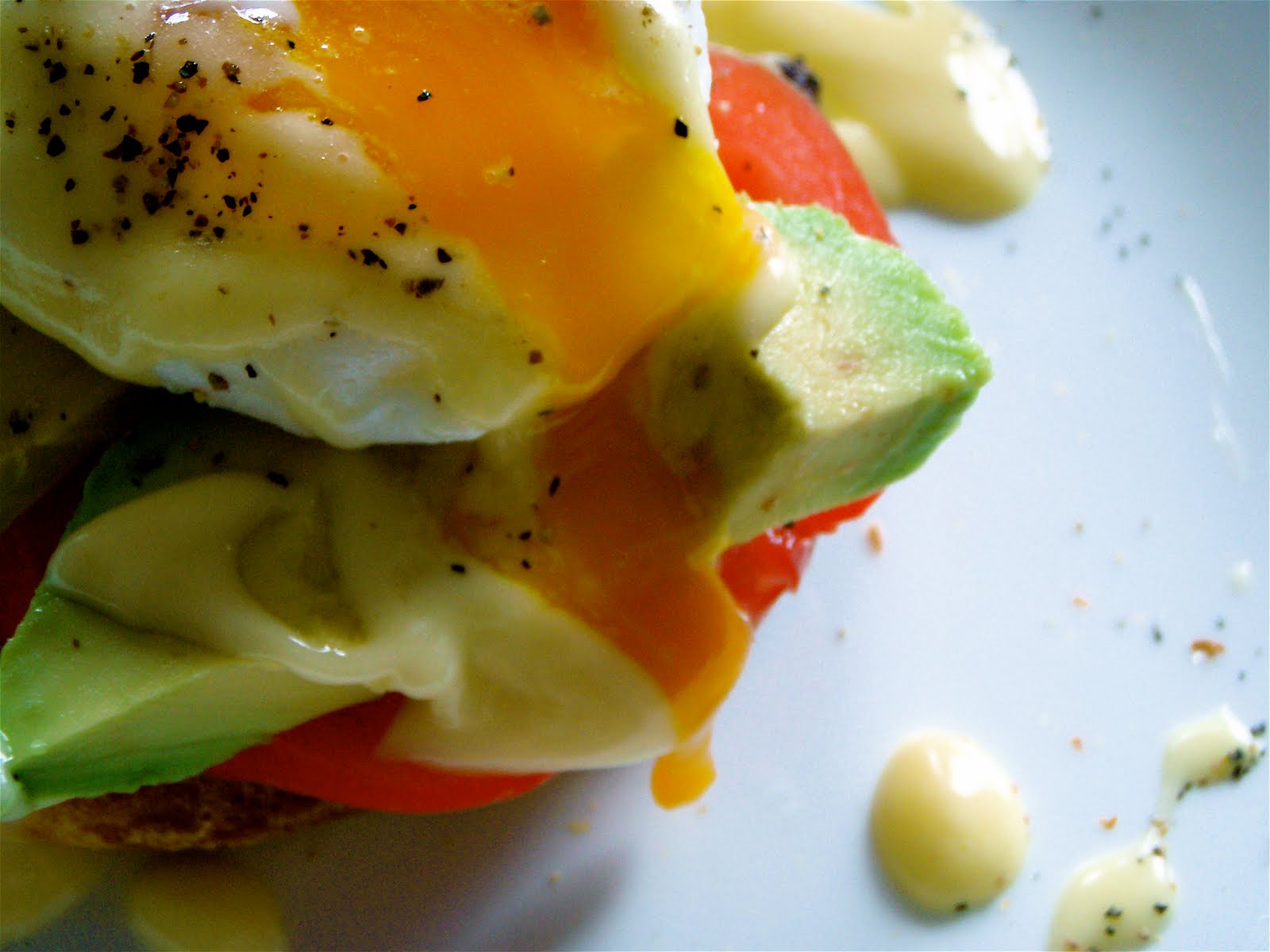
The photo at top captures a runny poached egg yolk on the precipice, just one component of a meal our staff interns whipped up that they referred to as "mega-brunch." Also on the menu were homemade popovers, eggs from friends(' chickens), hollandaise, and, at least in my case, three mimosas. These made climbing Mt. Pisgah a little difficult later in the day.
I've said it before and I'll say it again: I've said it before and I'll say it again: there is always spirited eating to be had in VT, thanks to the ingredients, the company, or both.
Heck, the compost pile that I overlook as I type has better produce in it than most supermarkets.
Tuesday, August 3, 2010
When Life Gives You Herb Blossoms...
.... make herb blossom water. Sounds delicious, doesn't it? No. It sounds like nothing. But an infusion of basil and mint blossoms is ethereal, cooling, and a good way to use up part of the plant that you're supposed to remove anyway.
They say that pinching the blossoms from herbs makes the plant redirect it's energy into producing more of what you want: fat, juicy, aromatic leaves. I've never tested an unpinched herb plant against a pinched one, so I can't speak from experience about the effect on your harvest, but going out and removing the blossoms every few days gives you a fun little job that makes you feel like what you do in the grand scheme of things is important: I pinch the flowers off of the basil plants, therefore I am.
But what to do with those decapitated blossoms? Keep basil flowers in your pocket and they'll make your keys smell nice, but they'll turn black. Keep them in a pitcher (or glass) of cold water and their oils will wend their way about the water molecules, imparting a fresh and slightly sweet taste to the drink.
Another interesting test would be this cold brew versus a hot steep. My guess is that, as in cold-brewed coffee, this eliminates any trace of bitterness. Unless you're a pollinator.